
 0
0
 0
0
By Correspondent, Harare
On a quiet Wednesday virtual gathering that brought together activists, researchers, grassroots organizers, and climate justice advocates from across Africa, one thing became unmistakably clear: the future of Africa’s energy transition cannot be written without women at the center of the story.
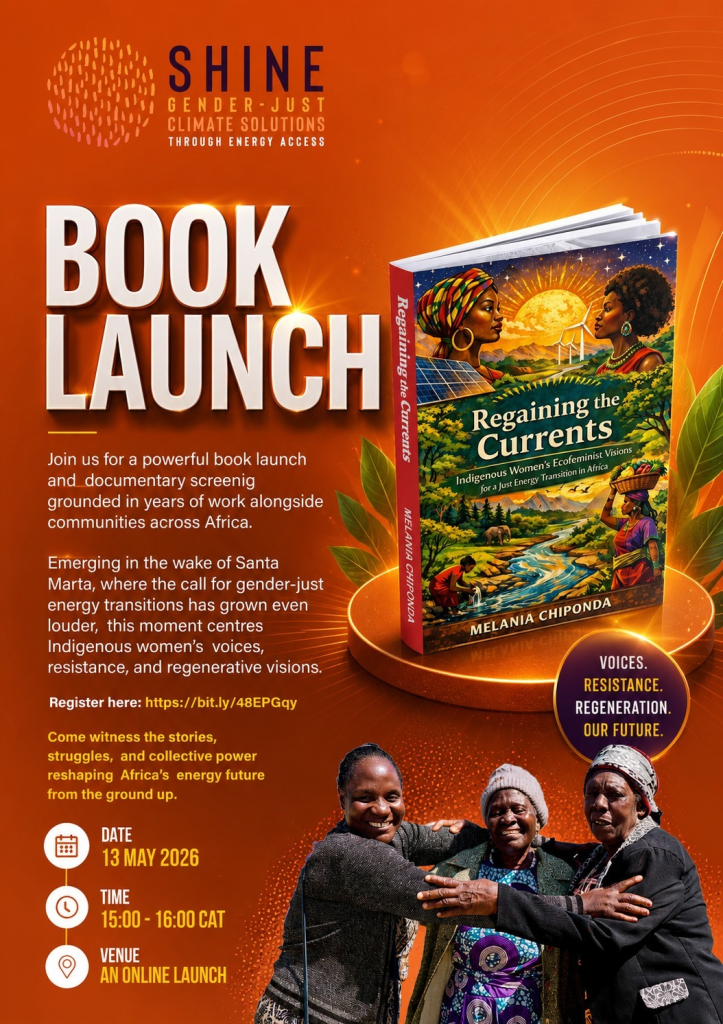
The launch of the book Regaining the Currents: Indigenous Women’s Ecofeminist Voices for a Just Energy Transition in Africa was more than a literary event. It became a deeply emotional and political conversation about land, memory, survival, and resistance. Through stories from communities in Zimbabwe, the Democratic Republic of Congo (DRC), and other parts of the continent, the book lays bare a difficult truth — Africa’s so-called green transition is increasingly reproducing the same injustices communities have endured for generations.
Yet amid the pain, women are organizing, innovating, and rebuilding alternatives rooted in dignity and collective care.
At the heart of the discussions were the experiences of the Vatombe women of Hanyanya in Zimbabwe and the women of Bukavu in eastern DRC, two communities separated by geography but united by extraction, displacement, and resilience.
The Women of Hanyanya: “We are losing the land that remembers us.”
As the launch began, participants were introduced to a moving video documenting the experiences of a community in Zimbabwe affected by lithium extraction. The story focused on the Vatombe people of Hanyanya, Bikita Province of Southeast Zimbabwe, whose ancestral lands now sit at the center of the global rush for minerals needed for electric batteries and renewable energy technologies.
The irony is not lost on the women.
The world speaks enthusiastically about clean energy, electric cars, and a fossil-free future. But in Hanyanya, women are watching trucks carve through sacred land under which lie thousands of graves of their ancestors, witnessing forests disappear, and fearing the erosion of cultural identity.
One speaker described how the community increasingly worries that the language of “just transition” is being used to justify new forms of dispossession.
“The women are asking very fundamental questions,” said Dr. Mela Chiponda, the presenter and executive director of the Shine Collab, a global feminist network that empowers women-led, community-driven renewable energy solutions in Africa and the Global South. “Who benefits from this transition? Who carries the burden? And why are communities who protected these ecosystems for generations now being pushed aside?” She asked.
For the Vatombe women, land is not merely an economic resource. It is memory, spirituality, food security, and identity. The land contains graves of ancestors, medicinal plants, rivers, and stories passed from one generation to another.
As mining activities intensify, women fear not only physical displacement but also the collapse of their social and cultural systems.
One participant reflected during the session:
“We are losing the land that remembers us,” said Gamuchirai Munesi, acting village head of the Vatombe community in Hanyanya village. That sentiment lingered throughout the launch.
The book documents how communities are responding through legal empowerment and grassroots organizing. Supported by the Shine Collab alongside partners including Earthlife Africa and the Bernstein Institute for Human Rights, young women in the community are being trained as paralegals to advocate for land rights and environmental justice.
Rather than positioning affected women as victims, the initiative treats them as researchers, strategists, and knowledge holders.
Tyler Walton, Deputy Director at the Bernstein Institute for Human Rights based at the New York University School of Law, US, praised the depth of community knowledge embedded within the project.
“These communities have a profound understanding of their land, traditions, and governance systems,” he said. “Legal empowerment is not about outsiders arriving with answers. It is about strengthening the capacity of communities to assert rights they already understand deeply.”
The project uses feminist participatory action research, a method that centers collective learning and lived experience. Women themselves document the impacts of extraction, map historical injustices, and generate policy demands.
In Hanyanya, this work has also led to the establishment of a solar-powered Just Transition Hub, a practical symbol of what community-led energy justice could look like.
The hub includes solar dryers, sewing machines, solar lighting systems, and clean cooking technologies donated by Earthlife Africa. Twenty solar cookers distributed within the community are already helping reduce dependence on firewood and slow deforestation.
But perhaps most importantly, the hub is becoming a political space. It is where women gather, learn, strategize, and reclaim agency over conversations that have long excluded them.
“This is not charity,” one organizer emphasized during the launch. “This is about creating spaces where women can shape the future on their own terms.”
Bukavu’s Women: Surviving Another Resource War
As participants reflected on the Zimbabwean story, another voice entered the conversation with striking familiarity.
Selina Sanou, a Kenyan and Malian energy and climate justice advocate working from a feminist perspective, drew powerful parallels between Hanyanya and Bukavu in eastern DRC. “If lithium extraction threatens the future of communities in Zimbabwe, the women of Bukavu already know what the violence of extraction looks like,” she said.
Eastern Congo has for decades carried the burden of the global appetite for minerals. Communities there have experienced cycles of conflict, exploitation, environmental destruction, and displacement tied to mining economies.
Selina described her recent visit to Bukavu and the painful similarities she observed.
“The stories of women in Bukavu are not far from the stories of women in Hanyanya,” she said. “The land encroachment, pollution, militarization, and silencing of women’s voices are deeply connected.”
In Bukavu, women spoke of rivers contaminated by mining operations, shrinking forests, and the growing burden of care work placed on women as ecosystems collapse.
Yet like the Vatombe women, they are refusing to surrender.
Selina described how women in Bukavu are building localized energy solutions to reduce dependence on charcoal and slow deforestation. Some are fabricating alternative cooking technologies and organizing around community-based renewable energy initiatives.
“They are not waiting for governments or corporations to save them,” Selina explained. “They are already imagining and building solutions.”
The comparison between Bukavu and Hanyanya exposed a sobering continental pattern: Africa’s mineral-rich communities are being asked to sacrifice their lands and futures for a global transition they did not design.
The women at the center of these struggles continue to ask whether the world’s climate ambitions will simply create “green sacrifice zones” across Africa.
Selina challenged researchers, policymakers, and climate institutions to rethink whose knowledge counts in the transition debate.
“We cannot continue designing energy futures without the women who hold generations of ecological knowledge,” she said. “Traditional knowledge is not backward knowledge. It is survival knowledge.”
Her words resonated strongly with participants.
Throughout the session, speaker after speaker emphasized the importance of free, prior, and informed consent for communities facing energy and mining projects.
Women, they argued, must not merely be consulted after decisions are made. They must participate meaningfully from the beginning.
Beyond Extractivism: Reclaiming the Meaning of “Just Transition”
The launch repeatedly returned to one central question: What does a truly just transition look like for African women?
For many participants, justice means moving beyond extractivism itself.
The book’s contributors argue that Africa’s energy transition must not replicate colonial patterns where raw materials are extracted from the continent while local communities remain impoverished and excluded.
One of the most striking parts of the initiative involves communities collectively reconstructing the history of Africa’s energy systems—from colonial-era exploitation to present-day mining booms.
Through timelines generated by community members themselves, participants traced how energy infrastructures historically served colonial and elite interests while marginalizing rural populations.
The process helped communities connect current lithium and cobalt extraction to older histories of dispossession.
“The transition cannot simply be about changing technologies,” one presenter noted. “It must also transform power relations.”
That transformation begins with centering grassroots women.
Throughout the launch, participants repeatedly praised the collaborative nature of the project. The Shine Collab team acknowledged the support of multiple partners, including Wallace Global and the Women, Environment, and Development Organization, whose support helped amplify African feminist voices in global climate spaces, including COP meetings.
There was also recognition of the role media can play in shaping public understanding.
Selina applauded efforts by groups such as Green Faith to train journalists and media houses to better report on women’s experiences in climate and energy struggles.
“If the media continues to tell the transition story only through governments and corporations, then communities will remain invisible,” she said.
A Different Future is Already Emerging
Despite the heavy themes of land dispossession and environmental injustice, the launch was ultimately defined by hope.
Participants celebrated the book not just as documentation of suffering but as evidence of organizing, imagination, and solidarity across borders.
Women from rural Zimbabwe, eastern Congo, and other African communities are increasingly speaking to one another, sharing strategies and building continental networks for climate justice.
The stories in Regaining the Currents reveal women who are no longer waiting to be included in policy rooms that overlook them. They are creating their own spaces of learning, advocacy, and innovation.
As the event concluded, attendees reflected on the collective vision emerging from the project.
One participant praised the initiative for demonstrating “what community power looks like when women lead.”
Another highlighted the practical significance of renewable technologies in rural communities, especially solar-powered systems that reduce environmental pressure while supporting livelihoods.
The atmosphere at the close of the session felt less like the end of a book launch and more like the beginning of a movement.
In many ways, Regaining the Currents is a challenge directed at governments, corporations, donors, and climate institutions across the globe.
It asks whether Africa’s transition will once again be built on extraction and exclusion, or whether the continent can chart a different path rooted in justice, participation, and care.
For the Vatombe women of Hanyanya and the women of Bukavu, the answer lies not in boardrooms or mining contracts but in communities reclaiming power over land, knowledge, and energy futures.
And perhaps that is the book’s most powerful lesson: the currents African women are trying to regain are not only electric but also
They are historical, cultural, political, and deeply human.


