 0
0
 0
0
By Shobha Shukla
“Dignified menstruation is rooted in the right to dignity, the right to freedom, the right to equality, and the right to non-discrimination. It means no matter whether menstruating persons are in the evacuation camp or refugee camp or camps for the war-affected population or any climate or manmade disaster relief camps, we need to prioritize the needs and priorities of menstruators,” said Radha Paudel, a nurse and activist in Nepal. Radha founded the Global South Coalition for Dignified Menstruation.
Radha challenges the conventional definition of menstrual discrimination, which is widespread globally in various forms. “Menstrual discrimination plays a vital role in the construction of the unequal power relation, patriarchy, and exclusion. It is the departure point when we talk about climate justice, menstrual products, or any kind of rights for menstruators. That is why, beyond the distribution of the menstrual pads or accessibility issues, we need to think of menstruators as human beings.
Most of the policies, even at the village level, often miss counting the menstruators in all diversities. Most of the conventional forms of assessment only discuss male and female and not persons with disabilities or LGBTQI communities, for instance.”
Do not call it a ‘sanitary’ pad, but a menstrual pad.
“I am not saying ‘sanitary’ pad because our blood is clean – it is pure blood – that is why I call upon everyone to call it menstrual pad or menstrual product instead of ‘sanitary’ pad,” said Radha Paudel.
“Distribution of free menstrual pads or menstrual products is a dehumanized and colonized mindset. The entire planning process misses out on the needs and priorities of menstruators. If we really like to ensure dignified menstruation, we need to realize that it is not only our right to dignity, but it is rather a composite outcome of the right to dignity, right to freedom, right to equality, and right to non-discrimination.”
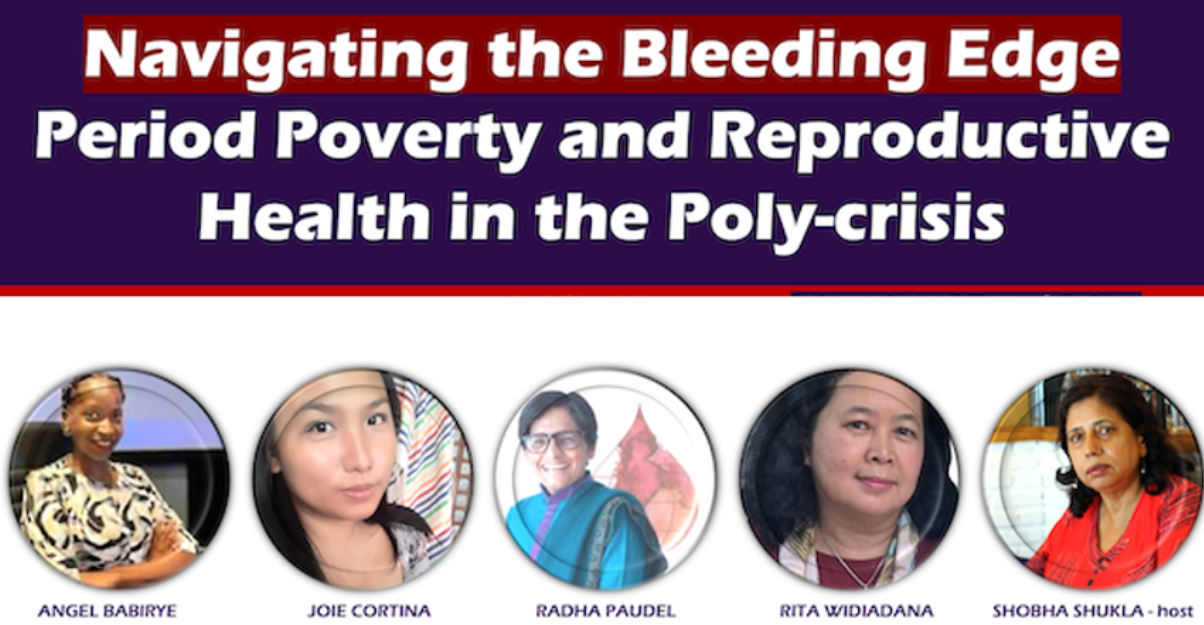
Radha was speaking at the SHE & Rights session to mark International Day of Action for Women’s Health and Menstrual Hygiene, organized by Women’s Global Network for Reproductive Rights (WGNRR) and CNS with Global Center for Health Diplomacy and Inclusion (CeHDI), International Planned Parenthood Federation (IPPF), Asian-Pacific Resource and Research Centre for Women (ARROW), and Asia Pacific Media Alliance for Health, Gender and Development Justice (APCAT Media).
Dignified menstruation is an enabler for sexual and reproductive health and rights.
“We must expose structural obstacles by highlighting how macroeconomic issues (inflation or climate change) manifest directly on the bodies of menstruating individuals. Achieving a period-friendly world is becoming radically more complicated today in this anti-rights and anti-gender era.
We are living through a poly-crisis, a period defined by the simultaneous, overlapping pressures of runaway inflation, climate-induced disasters, supply chain disruptions, and systemic poverty,” said Shobha Shukla, Coordinator and Host of the SHE & Rights campaign to advance gender equality and the right to health, both of which are fundamental human rights and inseparable and indivisible.
“For the 500 million people globally who experience period poverty every month, the poly-crisis has shifted menstrual hygiene from a basic healthcare right to an impossible financial trade-off. Families are increasingly forced to prioritize food and fuel over menstrual products,” said Shobha.
“Here in the Philippines, fires are rampant in the summer months. When a fire broke out in an informal settlement, we asked the affected and displaced communities what the need was. One item that they mentioned was underwear.
I can imagine if you are a person who is menstruating and you lost everything that you had in a fire; of course, you have to uphold your dignity. So, these things really affect the menstruators in a very visceral way,” said Joie Cortina, menstrual health and dignity advocate, and Programme Officer of Women’s Global Network for Reproductive Rights (WGNRR).
“When menstruators from a resource-poor background are already struggling to afford commodities like food or medicines, crises like climate affect their bodies and wellbeing too, as well as their ability to make decisions about their bodies, to advocate for themselves, and to demand essential commodities, including period commodities,” said Joie Cortina.
Similar situation in Indonesia. “In Indonesia, period poverty is driven mostly by financial constraints and inadequate infrastructure. “Climate change crisis and inflation affect women and girls especially during their menstruation period,” said Rita Widiadana, gender and health justice advocate and former editor of The Jakarta Post.
“In such crises, women and girls lost their safe spaces. They lost access to clean water and human dignity while facing increasing health risks. Indonesia had flooding, earthquakes, and conflicts, where women and girls suffered in evacuation centers. The majority of girls who live in low-income households, where sanitary pads are a luxury. When inflation comes, it means that the price of sanitary pads increases,” added Rita Widiadana.
“Relief efforts often neglect the needs of menstruating girls and women in difficult and challenging situations because they think food, water, and medicines are the essential priorities and menstrual products are ‘unimportant.’ Reality is far from this because menstrual products are not non-essential but critical for menstrual hygiene and dignity,” stressed Rita Widiadana.
Menstrual products are NOT luxury items but essential products.
“Inflation has affected not only African countries but globally, and one direct impact is the rising prices of menstrual products. Menstrual products are not luxury items. Ground reality for so many households is that a lot of those who are menstruating are unable to afford the very essential menstrual products. So many families are confronted with the dilemma if they should buy food for the household or sanitary pads for those who are menstruating. And in many families, it is not just one girl who is menstruating, which compounds the price for menstrual products.
This forces families to end up stretching the products beyond safe use. For example, a pad, if it is to be used for 6-8 hours, we find many people using it for longer hours or even for the whole day. This injustice has increased the susceptibility of young girls to reproductive tract infections. Also, menstruating girls and women are often left with no choice but to resort to unsafe alternatives, such as socks and dried dung, among others, which increases their susceptibility to reproductive tract infections,” said Angel Babirye, President, African Youth and Adolescent Network East and Southern Africa (AfriYAN ESA), and CEO of Us for Girls Foundation, Uganda. “Girls are forced to miss school when they fail to access or afford menstrual products promptly.”
Periods do not stop for wars or crises.
“We need to realize that periods do not stop for wars or humanitarian crises. That is why we must integrate menstrual health in disaster preparedness plans. Menstrual health must not come as an ‘afterthought’ when we are struck with disasters or crises. It is not just about the pads because it is also about access to clean water, privacy, and other essential needs of girls and women to feel safe and dignified.
One acute need is to promote menstrual literacy. Also, we need to engage boys and men. If a menstruating person has period pain, it needs to be understood by everyone that it is a real experience she and many others go through,” added Angel Babirye.
“In our experience, when it comes to preparing the menstrual dignity packs that will be distributed to families (affected by crisis), there is resistance to including sanitary pads or even underwear. It refers to the wrong idea that these commodities are ‘not essential’ and should not be prioritized like food or water. Menstrual products are NOT luxury products. Such harmful stereotypes affect the sense of dignity of menstruating individuals in crisis,” said Joie Cortina of WGNRR.
“We need to acknowledge the complex and multifaceted nature of menstrual discrimination. It is not a single event or act. A range of perceptions and practices, which includes silence, taboo, stigma, restriction, abuses, violence, and deprivation of resources and denial of services throughout the lifecycle of menstruators in all diversities. Unless we understand the complexity of menstrual discrimination, we cannot address menstruation or do lip service to ‘dignity,’” said Radha Paudel of Nepal.
“Because of menstrual discrimination, the menstruators may consider themselves inferior, powerless, and vulnerable, whereas non-menstruators consider themselves superior, powerful, and in control. Menstrual discrimination is reinforcing patriarchy and its unequal power relations and exclusion. Menstruating girls and women face this at home, in the education system, and all along,” added Radha Paudel. “We need to seriously incorporate dignified menstruation in all health, education, information, and behavioral change communication. Since all of humanity is formed from blood and the womb, menstruation is life-affirming rather than a source of shame or impurity.”
Gender justice advocates welcome the rebranding of PCOS to PMOS.
In May 2026, the International PCOS Network, in collaboration with The Lancet, officially renamed Polycystic Ovary Syndrome (PCOS) to Polyendocrine Metabolic Ovarian Syndrome (PMOS).
“The old name misdiagnosed the condition as simply ‘ovarian cysts.’ PMOS is a complex, systemic hormonal and metabolic disorder affecting 1 in 8 women worldwide, directly driving insulin resistance, mental health struggles, and irregular bleeding,” said Shobha Shukla of the SHE & Rights campaign and founder head of CNS.
Agrees Joie Cortina of WGNRR: “Historically, the lived experiences of women, especially in the so-called hard sciences, have always been relegated to the sidelines. Like the symptoms and experience (of pleasure or pain) of girls and women have always been relegated to the sidelines and deliberately unseen and unheard.
This welcome shift from PCOS to PMOS is reflective of listening, like providing menstruators with an epistemic privilege. It means that with this understanding, this is not just a gynecological issue and gives advocates like us knowledge of a more holistic approach to health.”


