 0
0
 0
0
By Christophe UWIZEYIMANA
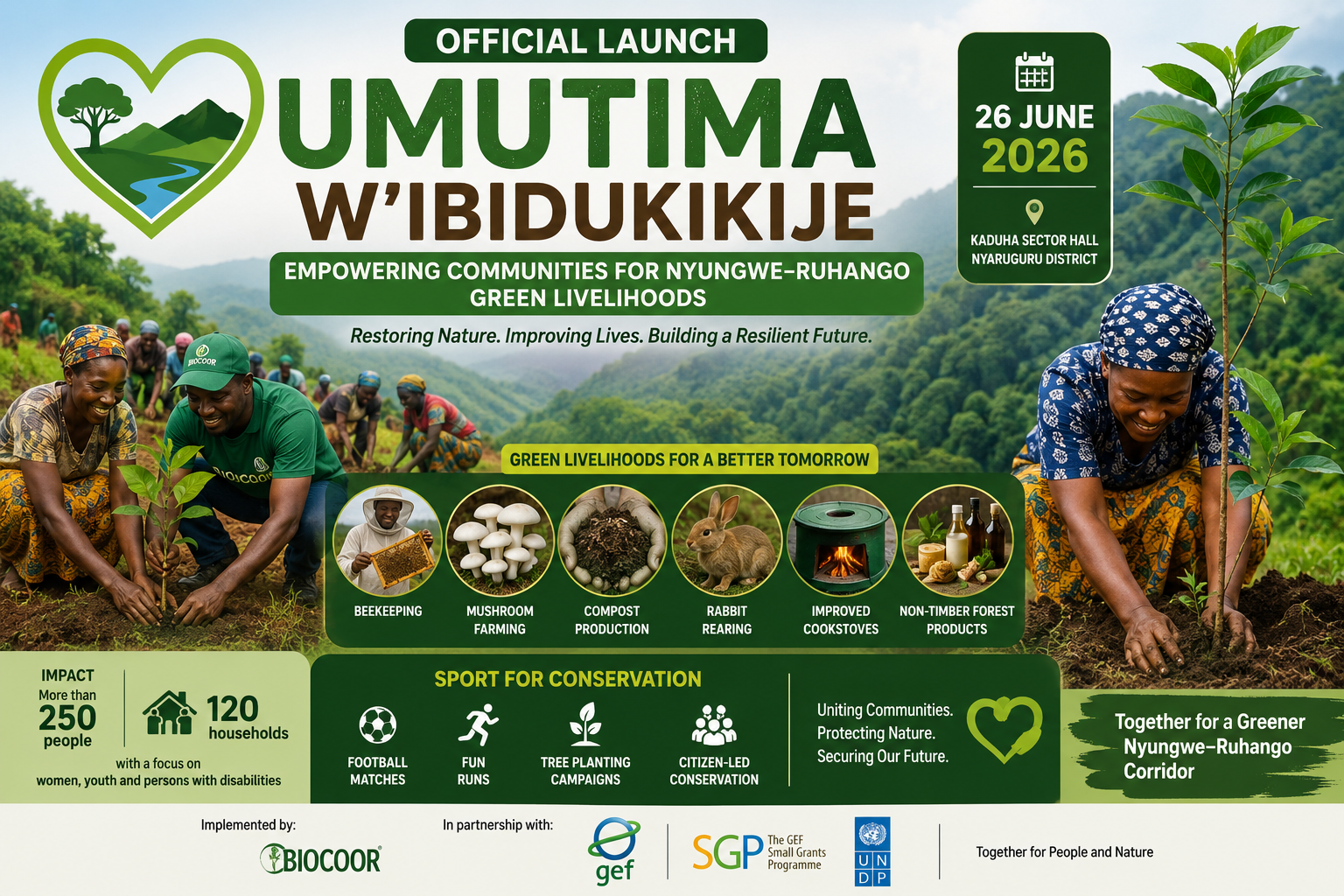
NYAMAGABE, Rwanda – A new community-led environmental conservation initiative, “Umutima w’Ibidukikije” (The Heart of the Environment): Empowering Communities for Nyungwe–Ruhango Green Livelihoods, was officially launched on 26 June 2026 in Kaduha Sector, Nyamagabe District. The project seeks to restore degraded ecosystems while creating sustainable livelihood opportunities for communities living along the ecologically significant Nyungwe–Ruhango Corridor.
The initiative comes at a time when communities surrounding the corridor are facing mounting environmental challenges driven by deforestation, land degradation, unsustainable farming practices, climate change, and increasing pressure on natural resources. These challenges have contributed to declining agricultural productivity, biodiversity loss, soil erosion, and reduced household incomes.
The project is being implemented by BIOCOOR in partnership with the GEF Small Grants Programme (SGP) through UNDP, with active participation from local authorities and communities.
Restoring Nature, Improving Lives
The Nyungwe–Ruhango Corridor plays a critical role in Rwanda’s environmental sustainability. It supports biodiversity, protects water catchments, strengthens climate resilience, and provides essential ecosystem services that millions depend on.
However, villages such as Muduha, Gitabage, Kirehe, and Kanyege in Nyabisindu Cell have experienced increasing environmental degradation over recent years.
Through the Umutima w’Ibidukikije project, communities will work together to restore 25 hectares of degraded land by planting approximately 36,400 indigenous and agroforestry trees. The project will also establish soil and water conservation measures designed to reduce erosion, improve soil fertility, and increase landscape resilience against climate change.
Beyond tree planting, the initiative seeks to strengthen community ownership of conservation by establishing environmental clubs, community conservation committees, and participatory ecosystem monitoring systems.
Conservation Meets Green Livelihoods
Recognizing that environmental protection and economic development must go hand in hand, the project places strong emphasis on sustainable income-generating activities.
Participating households will receive support to engage in:
- Beekeeping
- Mushroom farming
- Compost production
- Rabbit rearing
- Improved cookstove adoption
- Non-timber forest product enterprises
- Community savings groups to promote financial inclusion
These activities are expected to reduce dependence on forest resources while improving household incomes and strengthening resilience to climate-related shocks.
More than 250 people from 120 households are expected to benefit directly from the project, with special attention given to women, youth, and persons with disabilities.
Sport as a Tool for Environmental Action
One of the project’s most innovative components is its Sport for Conservation approach.
Instead of relying solely on traditional awareness campaigns, the initiative will use football matches, fun runs, tree-planting events, and citizen-led conservation activities to inspire environmental stewardship among community members.
Project organizers believe sports can serve as a powerful platform for educating young people, strengthening community participation, and promoting collective responsibility for protecting natural resources.
Building Local Ownership
The official launch, held at Kaduha Sector Hall, brought together 65 participants, including district and sector officials, community leaders, farmers, youth representatives, women’s groups, development partners, journalists, and technical experts.
The event provided an opportunity to introduce the project’s objectives, expected outcomes, and implementation strategy while encouraging collaboration among stakeholders.
Organizers emphasized that lasting environmental restoration can only be achieved through strong community participation and partnerships between local government, civil society organizations, and development partners.
Supporting Rwanda’s Green Development Agenda
The Umutima w’Ibidukikije project aligns with Rwanda’s national priorities on environmental protection, climate resilience, and sustainable development. By combining ecosystem restoration with climate-smart livelihoods, the initiative contributes to national efforts aimed at reducing poverty, restoring degraded landscapes, and conserving biodiversity.
The project also supports the objectives of the Global Environment Facility (GEF) Small Grants Programme, which promotes community-driven conservation initiatives that generate both environmental and socio-economic benefits.
Looking Ahead
As Rwanda continues to champion sustainable environmental management, initiatives like Umutima w’Ibidukikije demonstrate how local communities can become active custodians of natural resources while improving their own livelihoods.
For the residents of Muduha, Gitabage, Kirehe, and Kanyege villages, the project represents more than an environmental intervention—it offers a pathway toward greener landscapes, stronger communities, and a more resilient future.
If successfully implemented, the initiative could serve as a model for community-based conservation efforts across Rwanda, illustrating that protecting nature and improving livelihoods are complementary goals rather than competing priorities.


