 0
0
 0
0
By Shobha Shukla
African feminists demand a pause on the flawed AU violence convention as community services collapse and key populations face renewed criminalization.
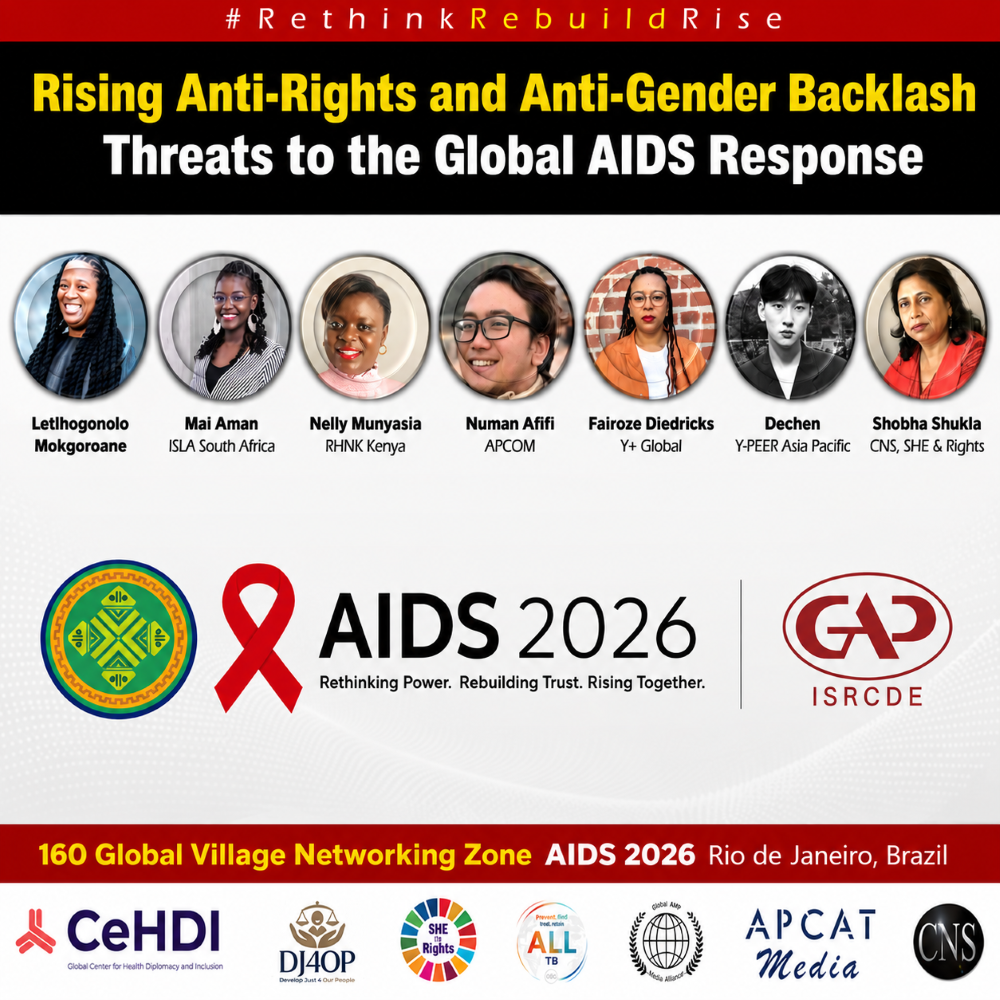
At the 26th International AIDS Conference (AIDS 2026) in Rio de Janeiro, rights advocates issued a stark warning: hard-won progress against HIV is under dual assault from organised anti-rights and anti-gender backlash and deep funding cuts. The SHE & Rights session, themed “Rising Anti-Rights and Anti-Gender Backlash: Threats to the Global AIDS Response,” co-hosted by the Global Centre for Health Diplomacy and Inclusion (CeHDI) and CNS with partners including IPPF, ARROW and APCAT Media, put these threats centre stage.
“Gender justice is the foundational bedrock to advance progress on each of the SDG targets and goals, including those related to health or ending AIDS and TB by 2030,” said Shobha Shukla, SHE & Rights Host and Coordinator and Executive Director of CNS. “With only 54 months left to deliver on 2030 targets, we are at a critical crossroads: Whatever progress has been made in the global AIDS response is threatened by the sinister rise of attacks on health and gender rights.”
Shukla highlighted the regressive draft ‘African Charter on Family, Sovereignty and Values’ as a direct threat to gender equality and the right to health. The draft urges African governments to withdraw from progressive agreements, including the Maputo Protocol of 2003, which has been central to protecting the reproductive and health rights of women and girls. A 2026 study across 47 countries found steep reductions in community-led services, including 82% cuts to services for sex workers and 72% to services for survivors of gender-based violence. “Gender equality is one of the strongest HIV prevention strategies. We cannot end AIDS without gender equality, bodily autonomy, and the leadership of women in all their diversity.”
Pause, Listen, Strengthen, Then Ratify
A major focus of the SHE & Rights session was a detailed legal critique of the African Union Convention on Ending Violence Against Women and Girls (AU CEVAWG) by Mai Aman, Legal Officer at the Initiative for Strategic Litigation in Africa (ISLA) and part of the Pause for Purpose campaign. The Pause for Purpose campaign supports decisive African action against violence but rejects the rush to ratify a text it argues is not yet fit for purpose.
“The Pause for Purpose campaign is a call to all stakeholders to pause, critically analyze the African Union Convention on Ending Violence Against Women and Girls (AU CEVAWG), and to form a view on whether the convention is fit for purpose,” Aman said. “That is why our message is simple and very clear: Pause, listen, strengthen, then ratify.”
Aman emphasised there is no contradiction between urgency and due diligence. A treaty is legally binding and will shape national legislation, policy, court decisions, and remedies for generations. The critical question is whether the present text strengthens protections already secured through the Maputo Protocol or introduces ambiguity and regression.
The campaign’s legal assessment identified concerns at three levels. First, serious process failures: many women’s rights organisations, survivors, and civil society groups were not meaningfully consulted. In a survey of approximately 1,500 organisations, only 33% were aware the convention was being drafted before adoption, while 93% reported they had not been consulted. “A treaty concerning African women cannot be developed without African women,” Aman stated.
Second, substantive legal weaknesses. The convention does not consistently articulate protections as enforceable rights with clear state obligations. Critical issues, such as female genital mutilation, child marriage, domestic violence, marital rape, trafficking, and conflict-related sexual violence, are not adequately addressed. Language on ‘family’ and ‘African values’ lacks clarity and risks being used by anti-rights actors to restrict women’s autonomy. The Maputo Protocol already provides strong protections in several of these areas; a new treaty must build on that foundation rather than weaken it.
Third, implementation, monitoring, and accountability gaps. Soft law cannot repair defects in a binding treaty. Amending a treaty after ratification is difficult. The safest approach is to correct the text before states become legally bound by it.
These concerns crystallized on 25 July 2026, when the Pan-African Parliament and others convened a high-level dialogue in Midrand, South Africa, focused on domestication and ratification. In response, the Pause for Purpose campaign and allies staged a peaceful protest, demanding equal voice for those calling for a pause, transmission of their memorandum to AU bodies, a pause on further ratification for independent expert review, and an inclusive revision process to align the convention with the Maputo Protocol and international standards.
“African women deserve more than a symbolic treaty. They deserve a convention that clearly names the violence they experience, creates enforceable obligations… We pause today, and we protect tomorrow,” Aman said.
Compounding Crises: Backlash Meets Funding Collapse
Numan Afifi of the APCOM Foundation in Thailand underscored how regressive instruments form part of a broader organised strategy. The global HIV response has delivered extraordinary progress: since 2010, new HIV infections have fallen by over 40% and AIDS-related deaths by 57%. Last year, 32 million people were on treatment. Yet in 2025 alone, 1.2 million people acquired HIV, and someone still dies of an HIV-related cause every minute.
“Just as the response faces an unprecedented funding crisis with deep cuts to HIV programs all around the world, it is being hit by a second crisis, an organized, well-funded anti-rights and anti-gender backlash. These two crises are not separate. They compound each other,” Afifi said.
On the legislative front, ‘family values’ bills and anti-propaganda laws are re-criminalising same-sex relations, sex work, and gender expression. Documents such as the Geneva Consensus Declaration and the draft African Charter are being used to water down global health and human rights norms. Community organisations are starved of resources, while LGBTQ+ people and the idea of gender are framed as dangerous ‘foreign ideologies.’
Criminalization and stigma push people away from testing, treatment, and prevention. Globally, the risk of acquiring HIV is 80 times higher among gay men and other men who have sex with men, 17 times higher among transgender persons, 34 times higher among people who inject drugs, and 17 times higher among sex workers, risks driven by marginalisation and criminalisation. In the Asia-Pacific, PrEP reaches only about 2.5% of those who need it, even as Fiji, the Philippines, and Papua New Guinea face some of the world’s fastest-rising epidemics.
APCOM’s calls are concrete: decriminalise same-sex relations, sex work, and drug use, and protect the rights of trans and gender-diverse people; protect and directly fund community-led organisations; reject regressive instruments; and close the prevention gap by scaling up PrEP. “Human rights are not separate from the HIV response; they are the response,” Afifi concluded.
“Kenya’s Shelves Go Dry”
In Kenya, the human cost is already visible. Nelly Munyasia, Executive Director of the Reproductive Health Network Kenya (RHNK), described how the 2025 USAID stop-work order exposed the dangers of siloed systems. When USAID left, ARVs, check-ups, referrals, community outreaches, counselling, and testing centers all came to a standstill.
“We saw shelves go dry,” Munyasia said. Family planning supplies also vanished. A baseline survey in five counties in late July 2026 revealed spiked numbers of unintended pregnancies, HIV infections and reinfections, and unsafe abortions. Girls are arriving at facilities with ruptured uteruses. Organised anti-ritts groups are leveraging the crisis while diversity language disappears from policies. Healthcare providers face surveillance, harassment, and arrests for offering abortion care or services to LGBTQIA communities and adolescents.
Dr Edison Oduor, Programme Director at RHNK, outlined a four-pillar response: building an intersectoral movement for sustainable SRHR aligned with government efforts; strengthening government systems rather than creating parallel programmes; integrating SRHR, HIV, contraception, maternal health, GBV response and other services into a single continuum of care; and investing in digital health innovations that extend confidential reach, particularly for gender-diverse individuals. “No single organization can replace donor funding,” Oduor emphasised. Only resilient, properly resourced government systems can deliver at scale.
Fragile Gains Across Asia Pacific
Across Asia Pacific, Sangeet Kayastha of YPEER Asia Pacific Center observed that progress over two decades- softer approaches to LGBTIQ issues, growing domestic HIV funding and decriminalisation in several countries- began reversing after COVID-19, well before recent US funding cuts. Domestic funding cuts have been substantial. Young people face reduced access to information; violence against LGBTIQ communities has spiked; and regressive measures in one country ripple across the region.
In Bhutan, youth advocate Dechen of Disability 2030 noted that the 2021 decriminalization of same-sex activity and subsequent policies allowed health centers in every district to provide check-ups, self-testing kits, and PrEP for key populations. International funding scarcities now place these programs at high risk. Continuity depends on government decisions to integrate HIV prevention into national plans and allocate domestic funds.
As the conference continues, the message from Rio is unambiguous. Rights are not optional add-ons to the HIV response. They are its foundation. Without them, and without the political will to defend and resource them, the extraordinary progress of the past two decades risks unravelling just as the world has agreed on the path forward to 2030 and beyond.