
 0
0
 0
0
By Bobby Ramakant
We are living in an age of aging with a fast-growing number of older people. Life expectancy has increased significantly over the past few years. Japan has nearly 100,000 people aged 100 or older – the highest in the world, with women comprising roughly 88% of this population. By 2050, the population aged 60 and above is projected to reach 2.1 billion (nearly one-fifth of the global population).
“The rights of older people have been neglected for a long time. At best, they are treated as recipients of charity rather than as assets to society. From my lived experience, I would like to reaffirm that we, the so-called elderly persons, are not asking for mercy. We are asking for our long-overdue rights. We need to be recognized, not as burdens, but as rights holders and as vital contributors to families, communities, economies, and public life. We do not need shelter homes but the right to live a fulfilling life,” said Shobha Shukla, founder and leader of Development Justice for Older Persons (DJ4OP) and host of SHE & Rights.
It is heartening to see that, finally, the UN has woken up to this reality and started the process of drafting a legally binding UN treaty to protect the human rights of older persons (formally called the United Nations Convention on the Rights of Older Persons). Shobha Shukla was one of those with lived experience when the drafting of a legally binding treaty began earlier this year.
This legally binding treaty would outlaw prejudices based explicitly on chronological age – in law, employment, and society; guarantee older adults the right to make independent decisions regarding their care and life choices; establish enforceable legal frameworks to protect older individuals from physical, emotional, and financial exploitation; ensure equitable, high-quality, and affordable physical and mental healthcare; and protect access to pensions, financial security, and inclusion in community life.
Meanwhile, the UN Human Rights Council has established an intergovernmental working group (IGWG) to draft this new international treaty.
While opening the intergovernmental working group meeting in Geneva earlier this year, Nada Al-Nashif, UN Deputy High Commissioner for Human Rights, who is a senior citizen herself, had said that “meaningful participation is essential.” Older persons themselves – in all their diversity, including older women, older persons with disabilities, those belonging to indigenous peoples, minorities, and rural communities – must be actively engaged in this process. Civil society organisations, national human rights institutions, and independent experts bring indispensable experience, data, and insight. An inclusive and transparent process will strengthen both the legitimacy and the quality of the outcome.”
The first session of this intergovernmental working group is slated to be held from 13 to 17 July 2026 in Geneva.
Decade of healthy ageing
The UN Decade of Healthy Ageing (2020-2030) is another global collaboration led by the WHO to improve the lives of older persons. In fact, one of the agendas at the ongoing global meet of health ministers (formally called the 79th World Health Assembly – WHA79 or WHA 2026) was a report on the Decade of Healthy Ageing 2020–2030.
The WHO Global Network for Age-Friendly Cities and Communities also demonstrates a strong global commitment to improving environments that help support older people to be and do what they value.
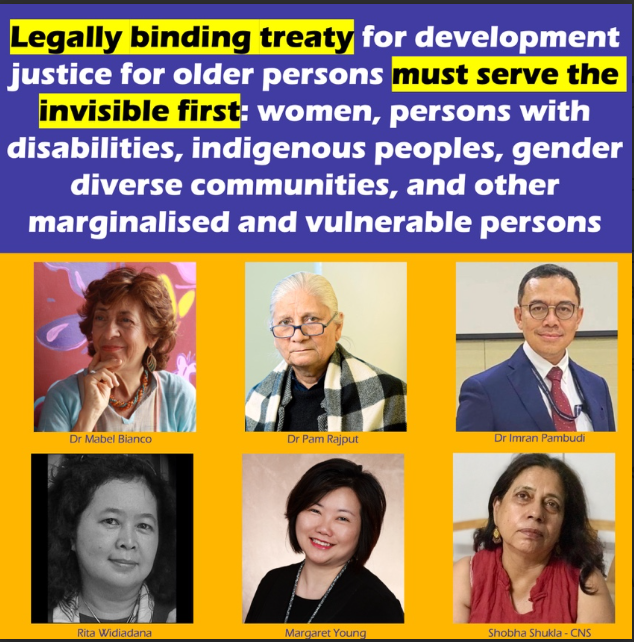
A special SHE & Rights session at the Women Deliver Conference 2026 in Australia focused on issues related to achieving the human rights of older persons with a focus on women, indigenous peoples, persons with disabilities, and other marginalised and vulnerable communities, with a lifecycle approach.
“Ageism is one big elephant in the room. It includes harmful norms, stereotypes, narratives, and tropes against older persons. It affects women more than men and the less educated more than the better educated. To be a gender-diverse person or a woman or one with a disability and to be elderly is double trouble in many countries, including India, more so if you stand up against ageism and do not fit into the norm. “Subtle nuances of ageism abound in every nook and corner and lurk where you least expect them – homes, society at large, workplaces, industries, healthcare facilities, media… the list is endless,” said Shobha Shukla, leader of Development Justice for Older Persons (DJ4OP).
In Argentina, social protection for older persons is fragile as it often lacks optimal resources, especially for healthcare, said Dr. Mabel Bianco, a noted feminist leader and founder of the Foundation for Studies and Research on Women (FEIM) and 2024 Director for Latin America and the Caribbean, International Federation of Ageing (IFA). Dr. Mabel agrees with Shobha Shukla that harmful stereotypes like ageism block access of older persons to sexual health services.
Dr. Pam Rajput, Emeritus Professor, Panjab University, India, and former Chairperson of the Government of India’s High-Level Committee on the Status of Women, shared her personal testimony of duty travels when she, being a senior citizen herself, needs to travel via airplane.
One question she is frequently asked is if she is traveling alone, which stinks of harmful stereotypes. Why is it difficult for people to comprehend that older persons, especially women, may also travel for work? Unless we normalize economic rights along with gender, social, and cultural rights of older persons, especially women, we would not be able to address ageism and the challenge that population aging poses.
In Indonesia, around 12% of the population are older persons (~35 million). By 2045, ~20% of the Indonesian population is expected to be older persons. This means that protecting the rights, health, and dignity of older persons is not a ‘future concern’ but a present responsibility. Persons with disabilities are twice as likely to face health problems,” said Dr. Imran Pambudi, Director of Vulnerable Groups Health Services, Ministry of Health, Indonesia.
According to Rita Widiadana, a senior citizen as well as a senior journalist and editor from Indonesia, “It can be challenging to live as an elderly person in Indonesia. For most women over 60, the challenges are even harder. The society and the media, as well, often associate older men with wisdom and rich experience, but elderly women are persistently portrayed as caregivers who are vulnerable and frail rather than independent and empowered individuals (and with wisdom and rich experience too).”
“It is unfortunate that media depictions of elderly women negatively affect societal perceptions that contribute to various forms of discrimination in families, in the workplace, and in daily life. It is high time for us to recognize the social and economic contributions that they make to their families and communities and to be included in a large variety of national development programs,” added Rita Widiadana, former editor of The Jakarta Post and board member of the Asia Pacific Media Alliance for Health, Gender, and Development Justice (APCAT Media). Rita is also on the advisory board of Development Justice for Older Persons (DJ4OP).
The word ‘retired’ reeks of ageism.
“At the workplace, there is the age-related archaic retirement system – the word ‘retired’ itself reeks of ageism. One does not retire (except perhaps when she/he/they are perpetually bedridden) as long as one lives. Yes, we do change our path and move in new directions. Instead, there must be support systems in place to ensure that older persons can choose with dignity and rights if they want to work or not and age with rights,” said Shobha.
Development justice needs to be a life-course justice
Margaret Young, Founder of Age Knowledge and past Chair of the Global Alliance for the Rights of Older People (GAROP), said that “development justice is strongest when older persons are recognized, included, and empowered. We speak often of gender justice, youth opportunity, and equity. Every young person is moving through the life course. Every girl may one day become an older woman. That means the rights of older women are not separate from the rights of younger women. They are part of the same life course story. Advancing the rights of older women strengthens gender justice across the life course. Developmental justice also needs to be life-course justice. Many inequalities accumulate across life and become sharper in older age. Lower earnings, unpaid care, widowhood, violence, isolation, and barriers to health and participation.”
Longevity is one of humanity’s greatest achievements. Yet the promise of longer life is too often accompanied by gaps in the protection of human rights. Instead of celebrating older age, most people fear it, and ageism fuels this fear.
“We, the older people, have to make sure that the lived realities of old age are adequately reflected in the proposed human rights framework. Ageism and gender inequality must end with us,” concluded Shobha Shukla.


