
 0
 0
As the global population ages, ensuring that older persons can live with equal rights, dignity, security, and good health has become a compelling human rights imperative. Yet, despite progress in international and regional human rights frameworks, older persons continue to face the onslaught of ageism, intersectional discrimination, poverty, social exclusion, and barriers to healthcare, social protection, and justice.
The demand for a dedicated legally binding treaty for the protection of older persons’ human rights is not new. In 1948, as the Universal Declaration of Human Rights was being drafted in Paris, Argentina formally proposed a “Declaration of Old Age Rights.” Nearly eight decades later, the UN Human Rights Council has established an Inter-Governmental Working Group (IGWG) with a clear mandate to draft a legally binding treaty that addresses the growing visibility of deep-rooted ageism and the lived realities of older persons across regions.
Persistent gaps in the existing framework
Khaled Hassine, Secretary of the Inter-Governmental Working Group at the Office of the United Nations High Commissioner for Human Rights, emphasised that the existing architecture leaves older persons insufficiently visible in data, statistics, and accountability mechanisms. Age discrimination, unequal treatment based on age, and the broader phenomenon of ageism, encompassing stereotypes, prejudice, and exclusionary practices, remain poorly recognised and weakly constrained.
Hassine notes that old age cannot be reduced to chronological years. Experiences of aging are shaped by social, economic, and personal circumstances across the life course. When older persons are under-represented in official statistics and human rights reporting, their needs are systematically overlooked in policy and service design. A dedicated, legally binding instrument (or a treaty) is therefore required not merely to restate existing rights but to establish a coherent global framework capable of ensuring their effective enjoyment.
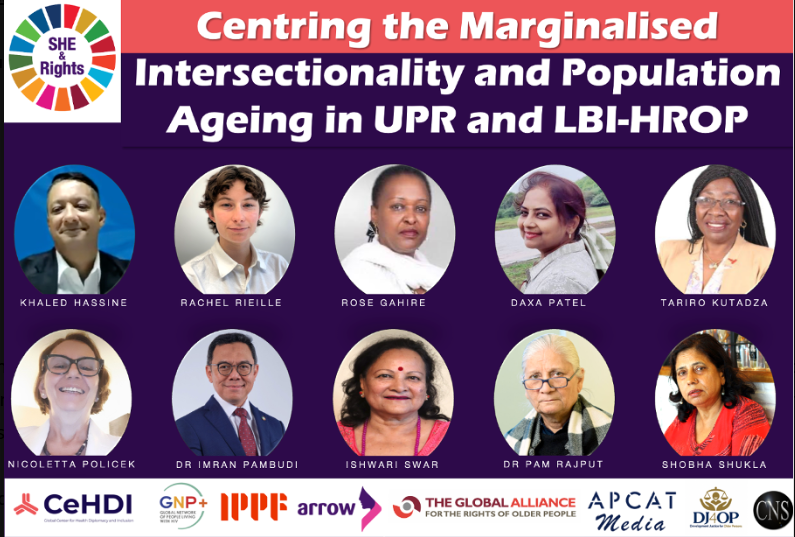
Khaled was speaking at the SHE & Rights session held ahead of the IGWG for human rights of older persons, organised together by the Global Center for Health Diplomacy and Inclusion (CeHDI) and CNS with the Global Alliance for the Rights of Older People (GAROP), the Global Network of People Living with HIV (GNP+), the International Planned Parenthood Federation (IPPF), the Asian-Pacific Resource and Research Centre for Women (ARROW), the Asia Pacific Media Alliance for Health, Gender and Development Justice (APCAT Media), and Development Justice for Older Persons (DJ4OP).
Addressing invisibility and structural discrimination of older persons
Despite the principle of ‘leaving no one behind,’ older persons remain largely invisible in human rights policies, data, and international monitoring mechanisms. This invisibility is particularly pronounced among older women, persons with disabilities, people living with HIV, indigenous peoples, gender-diverse people, and other marginalised communities. Shobha Shukla, CNS Executive Director and SHE & Rights coordinator, highlighted this fundamental contradiction, arguing that exclusion is often neither accidental nor unintentional. Systemic barriers, prejudices, and patriarchy can deliberately leave certain groups among older persons outside policy discussions and protection frameworks.
The scale of this exclusion is evident in the Universal Periodic Review (UPR), the UN Human Rights Council’s mechanism for reviewing the human rights records of Member States. Since its establishment in 2008, only 681 of more than 124,539 UPR recommendations have addressed older persons, representing around 0.5% of the total, said Shobha Shukla.
Health and Rights Observatory
Rachel Rieille, Data Manager at the Global Center for Health Diplomacy and Inclusion (CeHDI), reinforced this concern through her presentation of the Health and Rights Observatory, a free, public, and interactive platform designed by CeHDI, by connecting UPR recommendations with health indicators.
Rachel reported that among approximately 29,000 health-related UPR recommendations, only 144 specifically addressed the health of older persons. Although approximately 92% of these recommendations were supported by the governments, the issue remains significantly underrepresented.
This invisibility is both a cause and a consequence of ageism. When older persons are absent from data and reporting, they are absent from policy priorities. The Health and Rights Observatory’s capacity to track commitments, responses, and health outcomes offers a practical tool for civil society and policymakers to monitor progress and identify gaps, precisely the kind of evidence base a future convention’s monitoring mechanisms will require.
Why does a legally binding treaty matter?
A dedicated and legally binding treaty offers an opportunity to address longstanding protection gaps, clarify governments’ obligations, and strengthen accountability. It should build on existing international and regional standards while ensuring that older persons can enjoy all human rights equally throughout their lives, said Rose Gahire, Co-Chair of the Global Alliance for the Rights of Older People (GAROP). “Ageing is universal, but ageing with dignity, security, and respect is not yet a universal reality.”
She argues that a treaty must address ageism and discrimination that undermine older persons’ independence, employment, participation in policymaking, and protection during conflicts and natural disasters. It must also recognise that older persons are not a homogeneous group: their experiences are shaped by intersecting factors, including gender, disability, poverty, race, ethnicity, migration, displacement, and geographical location.
Existing regional frameworks, including the legally binding Protocol to the African Charter on Human and Peoples’ Rights on the Rights of Older Persons in Africa (came into force in 2024), provide valuable foundations that a global convention can complement and reinforce, said Rose. The guiding principle must be: Nothing about older persons without older persons.
Intersectionality: Diversity of older persons’ experiences
Aging does not affect everyone equally. Older women may experience poverty, economic dependence, unequal access to property, and gender-based violence. Older persons with disabilities may encounter inaccessible services, while older people living with HIV face stigma, fragmented healthcare, and inadequate social protection. Rural isolation, migration, sexual orientation, and gender identity can create additional barriers. Noted feminist Dr Pam Rajput, drawing on her experience in international law and informal diplomacy, called for civil society to engage actively in shaping the treaty. She highlighted the need to challenge longstanding patterns of exclusion and ensure that intersectionality is reflected in the final text.
Rajput argued that the instrument should build on existing standards, including the legally binding Inter-American Convention on Protecting the Human Rights of Older Persons (2015), that recognises multiple and intersecting forms of discrimination, rather than starting from a blank slate.
She also stressed that older persons must be valued for their wisdom, experience, and contributions. A meaningful human rights framework must recognise them as active rights holders, not merely recipients of care or protection.
Ageing with HIV: From survival to dignity with rights
The experiences of older people living with HIV illustrate why rights-based approaches must extend beyond clinical treatment.
Living with HIV for 42 years, Nicoletta Policek, co-founder and director of PRISMA, the European community-driven observatory on ageing and HIV, frames ageing with HIV as a question of rights, resources, and power. The ability of people living with HIV to grow older is a scientific and collective community achievement, yet many face discrimination, breaches of confidentiality, barriers to social protection, and fragmented care.
Nicoletta calls for community-led evidence to inform public policy and accountability. People ageing with HIV must help define priorities, assess services, and monitor government commitments. And governments should be held accountable to prevent discrimination against older people living with HIV, particularly in long-term care, she says.
“For me, this also means recognising our right to bodily autonomy, sexual health, freedom from violence and discrimination, and care that respects our dignity. Older women must have power in shaping these rights and holding institutions accountable,” said Nicoletta. “Living longer must also mean living with rights, dignity, and the power to shape our own lives.”
Tariro Kutadza, Advocacy Lead at the Zimbabwe National Network of People Living with HIV (ZNNP+) and founder-leader of TB People (Zimbabwe), and Daxa Patel, Co-Founder and former President of the National Coalition of People Living with HIV in India (NCPI+), highlighted the multiple health conditions, stigma, isolation, and treatment challenges experienced by older people living with HIV.
They called for strengthening peer-support networks, integrating HIV care with healthy ageing services, improving community-led monitoring and social protection, and stronger person-centered and gender-responsive services. For them, living longer with HIV is an achievement, but ageing well with dignity must be the next goal.
Ishwari Swar, founder-chairperson of the Senior Citizens Welfare Association Nepal, described how youth migration has left many rural communities in remote areas of Nepal populated largely by older people, often without family support, accessible healthcare, and adequate social protection. Despite legal protections, weak implementation, inadequate budgets, and limited access to essential services continue to undermine their rights.
Indonesia’s experience, presented by Dr. Imran Pambudi, Director for Vulnerable Groups at the Ministry of Health, offers examples of practical responses. These include integrated primary healthcare, free health checks, community-based long-term care and disability-inclusive services. Dr. Pambudi emphasised that older persons must be recognised not only as recipients of care but also as valued contributors to society.
Dr. Pambudi called for stronger health systems, sustainable financing, support for caregivers and improved international accountability. As he observed, “Ageing is a triumph of human development; our responsibility is to ensure that everyone can experience it with dignity, health and meaning.”
The UPR and tools such as CeHDI’s Health and Rights Observatory can help strengthen accountability by identifying gaps, tracking commitments and encouraging governments to adopt targeted recommendations for health rights of older persons.
A world that values human rights must ensure that age never becomes a justification for discrimination, invisibility or exclusion. As Rose Gahire of GAROP powerfully concluded: “Human rights do not diminish with age. Dignity has no expiry date.”


