
 0
 0
By Shobha Shukla
As wars and armed conflicts intensify, humanitarian emergencies deepen, and millions are forced from their homes, a multitude of crises unfold, largely out of sight. One of them is the growing threat of tuberculosis (TB), particularly drug-resistant TB.
According to the United Nations Office for the Coordination of Humanitarian Affairs, nearly 300 million people were estimated to need humanitarian assistance and protection in 2024. Also, at the end of that year, 83.4 million people were living in internal displacement worldwide, including 73.5 million displaced by conflict and violence.
These figures reveal a humanitarian crisis of extraordinary proportions. Yet behind the statistics lies another, less visible emergency: the growing vulnerability of displaced and conflict-affected populations to infectious diseases, including TB, and the increasing difficulty of providing them with diagnosis, treatment, and care. More importantly, efforts to prevent infection transmission, including drug-resistant ones, break down during such crises.
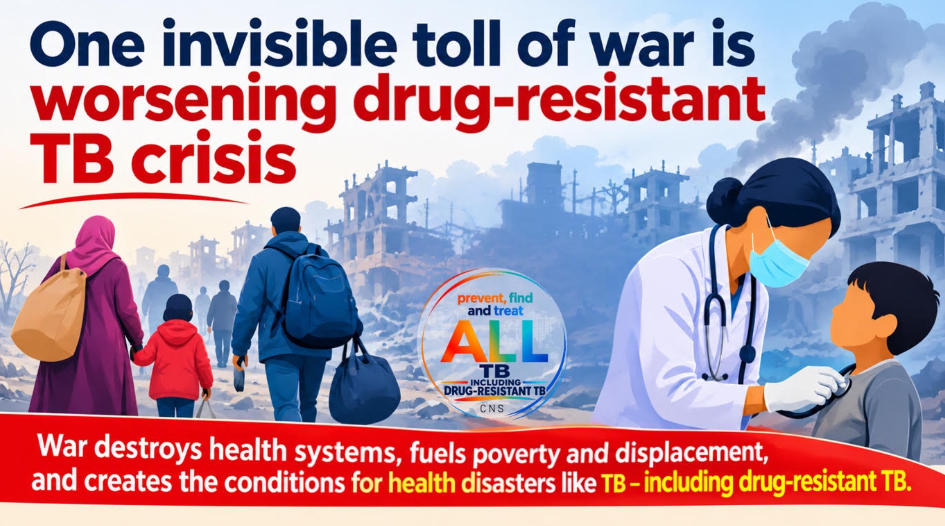
Against this backdrop, the global ambition to end TB faces a formidable obstacle. War does not simply interrupt healthcare delivery. It creates the very conditions in which TB thrives, spreads, and becomes more difficult to treat. And when disease prevention, diagnosis, treatment, care, and support systems collapse, the consequences can be even more devastating: drug resistance, avoidable deaths, and the potential emergence of new transmission chains extending beyond national borders.
The message from Dr. Ignacio Monedero Recuero, representing Action Damien and chairing the Global Drug-Resistant TB Initiative, is clear: the relationship between war, humanitarian emergencies, and drug-resistant TB can no longer remain a blind spot in the global TB response. He was speaking at a session organised by the Stop TB Partnership at the 55th Union World Conference on Lung Health in Rio de Janeiro, Brazil.
When war becomes a breeding ground for TB
Modern conflicts are increasingly prolonged, frequent, and deadly and disrupt or destroy essential services, including hospitals, electricity networks, water systems and other basic services.
According to the Internal Displacement Monitoring Centre, conflict-related internal displacement has increased by an average of 51% over the past decade, with a marked escalation since 2021.
Conflicts in the Democratic Republic of the Congo, Lebanon, Palestine, Sudan, Ukraine, and other settings illustrate the growing geographical reach of humanitarian crises. Also, prolonged conflicts in Afghanistan, Colombia, Syria, and Yemen demonstrate how emergencies can persist for years.
For TB, these circumstances create a dangerous convergence of risk factors. TB is closely associated with poverty, malnutrition, overcrowding, and inadequate access to healthcare. Drug-resistant TB is particularly concentrated among populations facing severe socioeconomic deprivation and inaccessible healthcare and social welfare support.
War and complex emergencies intensify virtually every known social and clinical determinant of TB. They destroy livelihoods, increase food insecurity, disrupt health services, create overcrowded living conditions, and push vulnerable communities into displacement, detention, and poverty. The economic consequences are equally devastating. Conflict destroys livelihoods, increases unemployment, and deepens poverty, limiting access to nutritious food, transportation, and healthcare.
Malnutrition and untreated conditions such as HIV and diabetes further increase vulnerability to TB. Overcrowded shelters, informal settlements, prisons, and refugee camps increase the risk of infection transmission.
Meanwhile, the destruction of diagnostic and treatment services means that people with TB may remain undiagnosed and infectious for longer periods. Untreated TB can lead to continued transmission, disability, and death, all of which could have been averted if peace prevailed. Inadequately prescribed or interrupted treatment can contribute to the development of drug resistance.
In this sense, war does not simply increase the risk of TB. It creates the conditions in which drug-resistant disease can flourish.
Perhaps the most alarming finding emerging from recent research is not simply the increased risk of drug-resistant TB in humanitarian emergencies, but the extent to which the disease remains undetected.
A 2026 scoping review, co-authored by Dr. Recuero and published in BMJ Global Health, found that fewer than 20% of estimated drug-resistant TB cases were notified in complex emergency settings.
This means that the vast majority of people who may have drug-resistant TB in these settings are not being identified and reported through existing surveillance systems. Many may never receive a diagnosis, while others may struggle to access appropriate treatment or maintain continuity of care.
But even without wars and conflicts, it is a chronic and gross neglect that only 38% of estimated drug-resistant TB cases were notified and put on treatment globally in 2025, as per the latest WHO Global TB Report 2026. This is not acceptable.
If we are to end TB, we have to end drug-resistant TB first: no one should get infected with drug-resistant strains of TB, and no one with drug-resistant TB should be left undiagnosed, untreated, unsupported, and uncared for. We need to find all people with drug-resistant TB and link them to effective treatment, care, and support, and boost infection prevention and control at all levels.
Most existing TB and drug-resistant TB guidelines were developed for relatively stable healthcare environments. The reality in conflict settings is very different. A patient may be unable to reach a health facility. A hospital may have been destroyed or lost electricity. Medicines may be unavailable because supply chains have collapsed. Health workers may have fled, while patients themselves may be forced to relocate repeatedly.
In complex emergencies, multiple known risk factors accumulate, creating conditions in which DR-TB transmission can accelerate while the capacity to detect and treat cases diminishes.
A crisis that crosses borders
The impact of conflict on TB is not confined to the countries where fighting takes place. Population displacement can alter the epidemiology of drug-resistant TB in neighboring and even distant countries.
The escalation of the war in Ukraine in February 2022 triggered the largest refugee movement in Europe since the Second World War. This movement had important implications for healthcare systems and TB services across Europe, particularly in countries such as Poland and Germany, which received substantial numbers of Ukrainian refugees.
The critical issue is not displacement itself, but the conditions surrounding it: disrupted treatment, limited access to diagnosis, exposure to overcrowded living environments, and difficulties maintaining continuity of care.
Population movements can also create additional challenges for surveillance and treatment. People may move between their country of origin, host countries, and third countries, seeking local integration, repatriation, or resettlement. Each transition can create another interruption in diagnosis, treatment, and follow-up.
Turning crisis into an opportunity for innovation
Yet the picture is not entirely bleak, said Dr. Ignacio Monedero Recuero. He shared the example of Ukraine, which demonstrates how flexibility, innovation, and patient-centered care can help sustain the TB response even under extremely difficult circumstances.
One significant development in Ukraine was the shift from highly centralised models towards more decentralised, community-based, and patient-centered services; the proportion of patients receiving outpatient treatment increased from 24% in 2021 to 65% in 2022.
The approach incorporated nutritional support, management of comorbidities, psycho-emotional assistance, and palliative care, alongside social support such as food packages, essential goods, and transportation.
Ukraine also accelerated the introduction of shorter drug-resistant treatment regimens (including BPaL and BPaLM) to reduce treatment duration, simplify care for eligible patients, and improve treatment outcomes.
Other innovations included providing patients with sufficient supplies of medication to maintain treatment if they are suddenly forced to flee or relocate; expanding access to molecular diagnostic platforms and ultraportable AI-powered X-rays; using mobile phone-based tools for treatment monitoring and follow-up; and introducing standardised training packages for primary healthcare workers.
These adaptations offer important lessons for other humanitarian settings: treatment must be designed around the realities of patients’ lives, rather than expecting patients to navigate healthcare systems that may no longer function as intended.
We cannot end TB without addressing war.
The ambition to end TB by 2030 cannot be achieved by focusing exclusively on biomedical interventions, diagnostic technologies, and treatment targets. It requires confronting the social, political, and humanitarian realities that sustain the epidemic.
War destroys the conditions necessary for good health. It creates poverty, malnutrition, overcrowding, and displacement. It weakens health systems, interrupts treatment, and increases the risk of antimicrobial resistance.
For the TB community, ignoring these realities means overlooking some of the most vulnerable populations and some of the most dangerous conditions for disease transmission.
The global response must therefore move beyond viewing conflict as a temporary disruption to routine TB programming. As conflict is becoming a prolonged reality, TB services must be designed accordingly.
This means integrating drug-resistant TB into humanitarian health planning, protecting essential health services, investing in resilient diagnostic and treatment systems, strengthening international cooperation, and ensuring that displaced people are never abandoned between healthcare systems.
It also means recognising that the right to TB diagnosis and treatment does not disappear when a country goes to war.
Protecting healthcare workers, safeguarding health facilities, maintaining humanitarian access and ensuring the continuity of essential medical supplies are not peripheral concerns. They are fundamental requirements for controlling TB and antimicrobial resistance in conflict settings.
And let us not forget that any conflict intensifies existing gender inequalities, making women more vulnerable to its devastating impacts. Women and gender-diverse people living in war-torn and conflict zones face additional barriers to TB prevention, diagnosis, treatment and care. Addressing TB in conflict zones requires a gender-responsive, inclusive and human-rights-based approach that ensures everyone- irrespective of class, race, gender, sexual diversity, can access prevention, diagnosis and treatment safely, equally and with dignity.


