 0
 0
By Annonciata Byukusenge
High blood pressure often develops silently, with pressure building in the blood vessels until they are damaged because they can no longer cope with the volume of blood passing through them. Yet some Rwandans still mistake the condition for the result of poisoning.
The World Health Organization (WHO) estimates that 1.4 billion people worldwide, or 33% of those aged 30 to 79, had hypertension in 2024. Nearly 600 million of them did not know they had it. Hypertension.
In Rwanda, the WHO says about 1.2 million people in that age group, or 25%, were living with hypertension in 2024. Only about 304,000 had been diagnosed, and just 86,000 had their blood pressure under control. Across Africa, more than 46% of people aged 25 and over have high blood pressure.
Several residents of Huye District told Forefront Magazine it can be hard to tell whether high blood pressure or a curse is to blame for how they feel. They said the behaviors have shifted, however, thanks to public messaging on preventing non-communicable diseases, including hypertension.
“I thought it was a rich person’s disease.”
Maria Nakabonye, 70, who lives in Huye Sector, said she has had high blood pressure for 25 years but did not see a doctor early on.
“It’s hard for someone who feels unwell to go to a doctor first, because they assume they’ve been poisoned. I went to a traditional doctor first and was given traditional medicine, but it did nothing for me.”
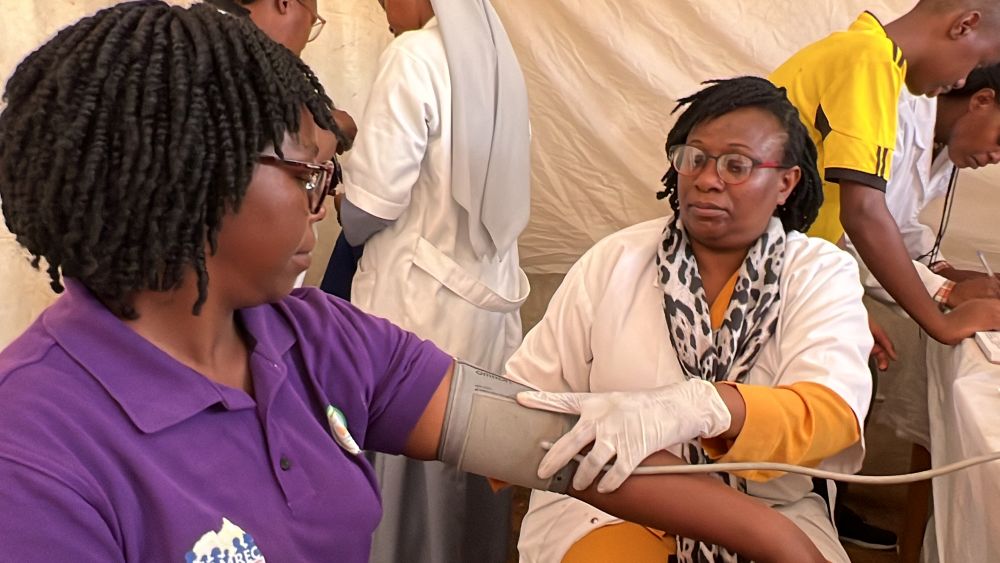
She said her children took her to a health facility against her wishes when they saw how ill she was, and tests there showed she had high blood pressure.
“Changing my thinking was difficult, because I believed hypertension was a disease of the wealthy. But the community assemblies urged us to get checked. The first time I went to the doctor, my children took me by force, and that was when I learned it was high blood pressure. I had suspected poison. I started taking medication, and, following the doctor’s advice, 25 years later I still feel strong.”
She added that she later developed diabetes, which has left her deaf in one ear.
Alphonsine Dusabimana, a community health worker in Huye Sector, said the assemblies have carried health messages since the program began nationwide in 2000, including advice on preventing non-communicable diseases such as hypertension.
“A community assembly is held every Tuesday, and prevention of non-communicable diseases, including high blood pressure, is always on the agenda. We also go door-to-door because some people have hypertension and don’t know it. We encourage them to get screened, because the service is free.”
Ancille Mujawamariya, 80, said she fell ill last year and was found to have high blood pressure at a health facility.
“The community health worker kept telling us at the assembly to go to the doctor quickly if we feel unwell, especially at my age. When I went, they found I had high blood pressure. They gave me medication and dietary advice and told me to come back when the pills ran out.”
She said she took the medication for about a month and followed a balanced food. When she returned, tests showed her blood pressure had returned to normal.
“I was so happy that I keep telling other elderly women to see a doctor as soon as they feel unwell and to stop turning to traditional healers.”
Public exercise sessions or mass sports
The assemblies are not the only channel for these messages. The government has also introduced community sports sessions to help people exercise, since some are too busy with work to find the time.
The push against non-communicable diseases gained momentum in 2016, when the City of Kigali launched a monthly mass sports day. The initiative is run with the Ministry of Health, the Rwanda Biomedical Centre (RBC), and the Rwanda NCD Alliance.
Because turnout was high, the sessions were expanded in 2017 to take place twice a month, on the first and third Sundays. They are now held nationwide and are open to everyone.
Symptoms and risk factors
High blood pressure often shows no early symptoms. When they do appear, they can include severe headaches, dizziness, nosebleeds, difficulty breathing, swollen feet, and blurred vision.
Risk factors include aging, particularly after 45; obesity; a high-salt food; heavy drinking; smoking; physical inactivity; kidney disease; diabetes; and a food high in fat.
Left untreated, hypertension raises the risk of heart disease, stroke, kidney damage, and eye damage and can lead to blindness.
Health officials urge screening.
Dr. Evariste Ntaganda, who monitors non-communicable diseases at the RBC, said the condition is dangerous precisely because it is slow to show symptoms and kills silently, which is why authorities have put prevention measures in place.
“Among the main causes are heavy drinking and poor attention to food. At the mass sports sessions, anyone found to be ill is followed up immediately. People with heart disease are referred to Rwanda Military Hospital in Kanombe and King Faisal Hospital for surgery, because heart disease is also a non-communicable disease.”
He said these diseases no longer affect only older people but increasingly younger ones too and urged people to exercise and eat balanced food.
Ntaganda recommended that women aged 35 and over and men aged 40 and over have their blood pressure checked every year at a health centre. He also advised people to cut back on salt and alcohol, quit smoking, eat plenty of fruit and vegetables, and exercise for at least 30 minutes three times a week. Those already diagnosed should take their prescribed medication correctly, he said.
Non-communicable diseases on the rise
A 2025 report from the National Institute of Statistics of Rwanda (NISR) said non-communicable diseases accounted for 49.5% of all recorded deaths in health facilities, compared with 40% for communicable diseases.
That marks a sharp change from 2019, when communicable diseases made up 70% of deaths and non-communicable diseases 27.9%.
The share of deaths from non-communicable diseases has climbed steadily over the past six years: 34.7% in 2020, 41% in 2021, 45.4% in 2022, 46% in 2023, and 47.7% in 2024, before reaching 49.5% in 2025.


