
 0
0
 0
0
By Shobha Shukla
“The regressive draft African Charter on Family Sovereignty and Values is yet another assault on sexual and reproductive health rights and justice, as well as bodily autonomy and human rights in general. More importantly, this draft charter urges African governments to withdraw from progressive, rights- and evidence-based agreements, including the historic and legally binding Maputo Protocol of 2003, which has been playing a defining role in promoting gender equality as well as protecting reproductive and health rights of women and girls in Africa.
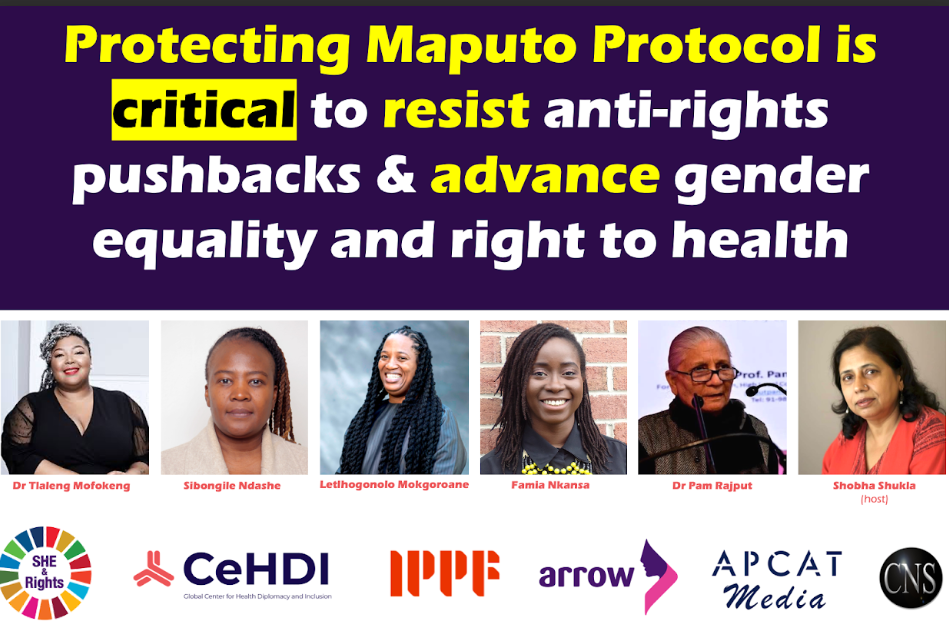
Among growing global anti-rights and anti-gender pushbacks, this draft charter is an additional attack that is attempting to backslide progress made on gender equality and human rights to health,” said Dr. Tlaleng Mofokeng, United Nations (UN) Special Rapporteur on the Human Right to Health.
“This draft charter is the first African continent-wide patriarchal push to dislodge human rights and replace rights with so-called ‘moralistic’ viewpoints. We cannot undo progress made by years of dedication and decades of struggle, which have resulted in strong and legally binding commitments, such as those enshrined in the Maputo Protocol. Governments need to disengage with this draft charter and instead honor and deliver on the promises they have made on gender equality and human rights to health, where no one is left behind,” stressed UN Special Rapporteur on Right to Health Dr. Mofokeng.
She was delivering her opening address at the June session of SHE & Rights hosted by the Global Centre for Health Diplomacy and Inclusion (CeHDI), International Planned Parenthood Federation (IPPF), Asian-Pacific Resource and Research Centre for Women (ARROW), Asia Pacific Media Alliance for Health, Gender and Development Justice (APCAT Media), and CNS.
“Gender justice and human rights to health are not negotiables. Rather, these are essential bedrock for human development, for sustainable peace and security,” concluded Dr. Mofokeng.
An analysis of the draft done by the Initiative for Strategic Litigation in Africa (ISLA) shows that this draft charter is not merely conservative, but it constitutes a sinister restructuring of rights through legal distortion. The rights language is retained in form, but the rights protection is weakened in substance. Sovereignty is used to resist accountability, and family protection is used to justify exclusion. Culture is invoked to limit equality protections, and human rights are reframed as a foreign ideology.
The draft charter defines family through the lens of a marriage between a man and a woman. “This directly conflicts with established international and regional human rights laws and jurisprudence. The practical implication is profound because family recognition determines access to inheritance, housing, custody, migration status, social protection, and legal recognition before the state. The draft charter frames the family as a primary unit for policy design, governance, and service delivery. It prioritizes family welfare, family cohesion, and family authority above individual consideration. This becomes especially dangerous when families themselves are sites of violence, coercion, discrimination, or unequal power relations.
The draft charter provides no safeguards to ensure that prioritizing family cohesion cannot override women’s rights, children’s rights, bodily autonomy, or protection from abuse. It also introduces a ‘family impact lens’ requiring laws and policies to be evaluated according to their impact on family stability, cohesion, and family values,” said Sibongile Ndashe, Executive Director, Initiative for Strategic Litigation in Africa (ISLA).
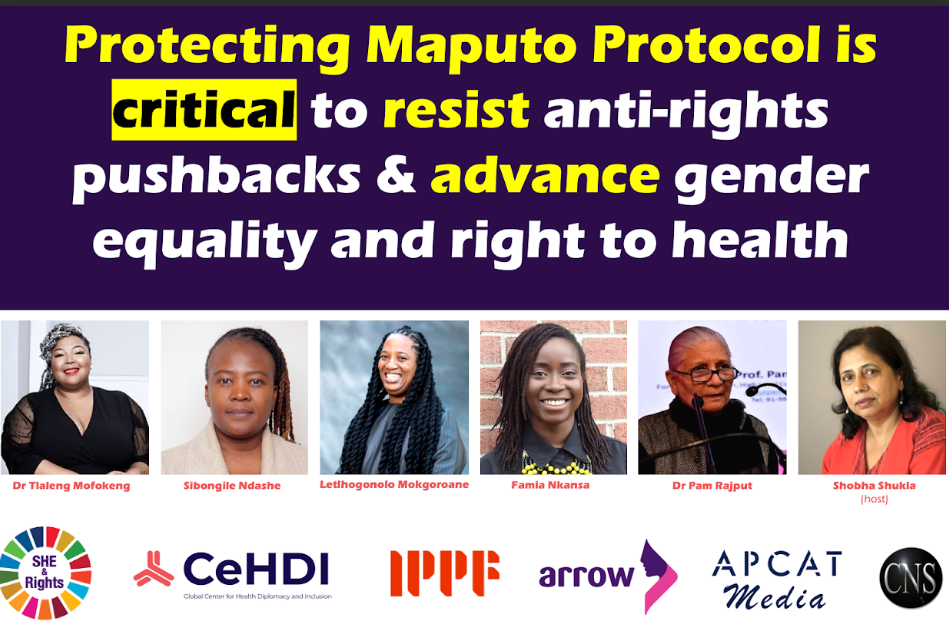
Ndashe was speaking at the SHE & Rights session on ‘Protecting the Maputo Protocol is critical to resist anti-rights pushbacks and advance gender equality and the right to health’.
Agrees Letlhogonolo Mokgoroane, South African legal practitioner (barrister): “The draft charter excludes protection related to gender identity and sexual orientation. What it does to gender-diverse persons is erasure, legal, political, and physical. It defines gender as limited to male and female, erasing the existence of intersex and gender-diverse persons.
It defines family exclusively through heterosexual marriage and biological parenthood, excluding same-sex families, single-parent families, and chosen families from any legal recognition or protection. It makes no recognition of gender-diverse families, gender-diverse parents, or gender-diverse children. In a ‘world’ the draft Charter wishes to construct, these people do not exist, and when the law says you do not exist, the consequences are not abstract.”
“The draft charter also rejects comprehensive sexuality education, the very education that evidence has shown leads to better sexual and reproductive health outcomes, lower rates of HIV transmission, lower rates of unintended pregnancies, and lower rates of gender-based violence. The draft Charter replaces evidence with ideology and public health with moralism.”
Sovereignty versus the individual
ILSA’s Ndashe rightly points out that the draft Charter expands sovereignty to justify extensive state control over morality, health, education, sexuality, and family life.
For Famia Nkansa, Communications Lead at Purposeful, a feminist hub rooted in Sierra Leone, “This draft charter is dangerous because it frames sovereignty as something that the state is entitled to versus the individual. When they portray gender equality as a threat to ‘social stability,’ when they portray sexual and reproductive rights as ‘foreign agendas,’ and when they mobilize fears about social change and then present themselves as ‘defenders’ of ordinary people against elites, it is not accidental.
This family-valued draft charter is attempting to substitute a frame from autonomy, equality, dignity, and bodily integrity to sovereignty, parental authority, tradition, and cultural preservation. The draft Charter wants to reframe human rights protections as ‘foreign impositions’ rather than African aspirations.”
Why protect the Maputo Protocol?
The Maputo Protocol is a legally binding human rights treaty adopted by the African Union in 2003 to guarantee comprehensive rights for women and girls across Africa. It has been ratified by 46 of the 55 African Union member states.
In the words of Letlhogonolo Mokgoroane: “It is one of the most widely accepted and most progressive human rights instruments on the African continent. It prohibits discrimination against women; guarantees the right to dignity, including protection from all forms of violence; guarantees the right to life, dignity, and security; and calls for the elimination of harmful practices, including female genital mutilation and forced marriages. Article 14 guarantees women’s rights to health, including sexual and reproductive health.
It obliges governments to authorize medical abortion in cases of sexual assault, rape, incest, and where continued pregnancy endangers the mental and physical well-being of the life of the mother or the fetus. Feminist advocates have reaffirmed the Maputo protocol as what it is, a weapon of resistance, solidarity, and accountability.”
Famia Nkansa argues that the Maputo Protocol is significant not only because of its legal protections but also because of what it symbolizes. It demonstrates that gender equality and women’s rights are not external concepts that were imposed on Africa, but they are principles that African governments themselves negotiated and adopted. African women activists, policymakers, legal experts, and governments played a central role in shaping the protocol.”
Growing global backlash against gender rights
Nkasa sees “a narrative shift that will eventually land us in a place where rights are rolled back on an unprecedented scale. We need to fight it with everything we have because they are coming for everything we have.”
Agreeing that the draft African Charter will take us in the reverse direction, Dr. Pam Rajput, Professor Emeritus, Panjab University, and former Chairperson of the Government of India’s High-Level Committee on the Status of Women, fears that this anti-rights pushback is not an issue for Africa alone. “Patriarchy is transnational, and so are all anti-rights movements. The question is not what the draft Charter means to Africans. The question is what it means for the future of women’s rights everywhere. This issue is not only regressive but also contagious. The anti-rights narrative travels quickly through transnational conservative networks. Rollback of rights in one region can become a precedent elsewhere.”
How do we counter the anti-rights pushes and advance gender equality and the right to health?
For Letlhogonolo Mokgoroane, “The movement to defend gender-diverse lives on the African continent is not asking for special treatment. It is asking for the right to exist, to be recognized, and to be protected. The draft charter’s answer is ‘No.’ Our answer must be a louder YES. Let us protect the Maputo Protocol. Let us defeat the draft Charter. Let us hold our states (governments) to account. Let us insist with every tool available to us, legal, political, and moral, that gender equality and the right to health are not negotiable, not reversible, and not foreign. They are constitutional. They are human rights, and they are ours.”
Dr. Pam Rajput calls for the inclusion of all global voices in support of the Maputo Protocol and against the proposed draft African Charter. “We must resist collectively, and feminist solidarity must be global. In 1993, the Vienna Declaration, adopted by consensus, declared that women’s rights are human rights. It serves as a universal blueprint for strengthening human rights, declaring that all human rights are universal, indivisible, interdependent, and interrelated. Human dignity and human rights are not divisible by geography. Human rights cannot be selectively applied or culturally withdrawn at the will of some people. We need to challenge anti-rights narratives and build cross-regional alliances to reaffirm the universality of rights.”
Letlhogonolo reminded us that South Africa and Mozambique were the two nations that abstained from supporting the regressive draft charter. South Africa said that it cannot support provisions that conflict with its constitutional framework and legal obligations… But abstinence is not resistance. We need South Africa to move from a constitutional objection to an active continental objection to lead a coalition of states that reject this draft Charter outright and campaign against its adoption at the African Union.”
Only 54 months left to deliver on gender equality (SDG-5) and health (SDG-3)
“Only 54 months are left to deliver on the promise of gender equality, SDG-5, and health and wellbeing, which is SDG-3, by 2030. But the sense of urgency and purpose is missing. If we recognize that the world is not on track to deliver on either of these goals, instead of going forward in many instances, we are slipping backwards. Gender equality and human rights to health are fundamental human rights, and both are indivisible or inseparable.
But despite this, anti-rights and anti-gender pushbacks have been growing, stalling and, at times, trying to reverse whatever progress has been made on gender and health rights, especially for girls and women and gender-diverse communities,” said Shobha Shukla, SHE & Rights Coordinator.


