 0
0
 0
0
By Shobha Shukla
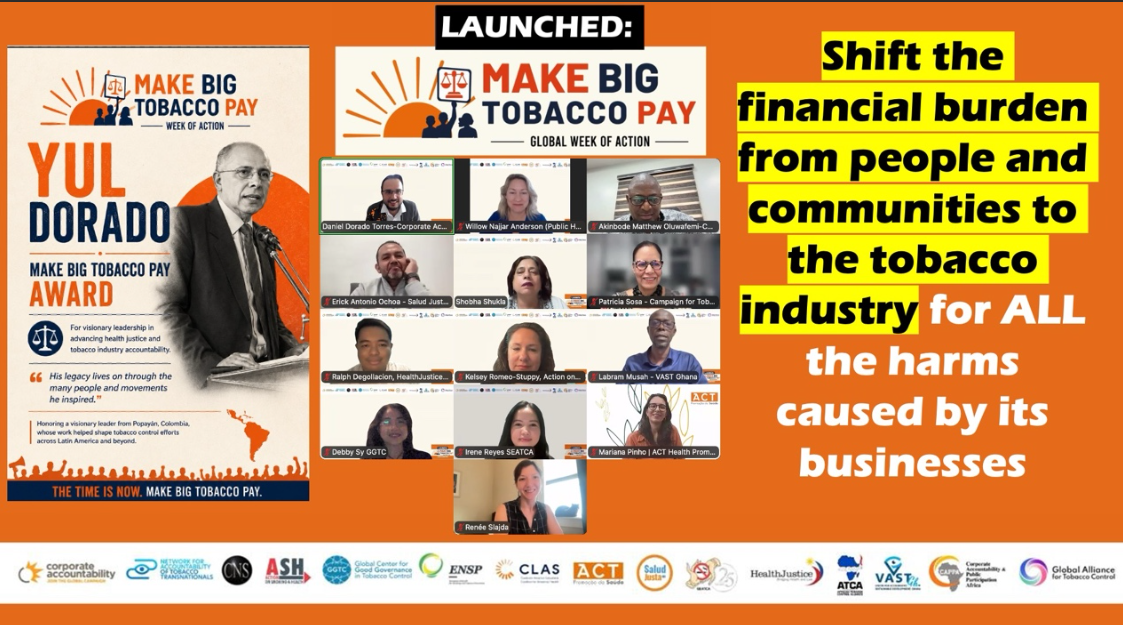
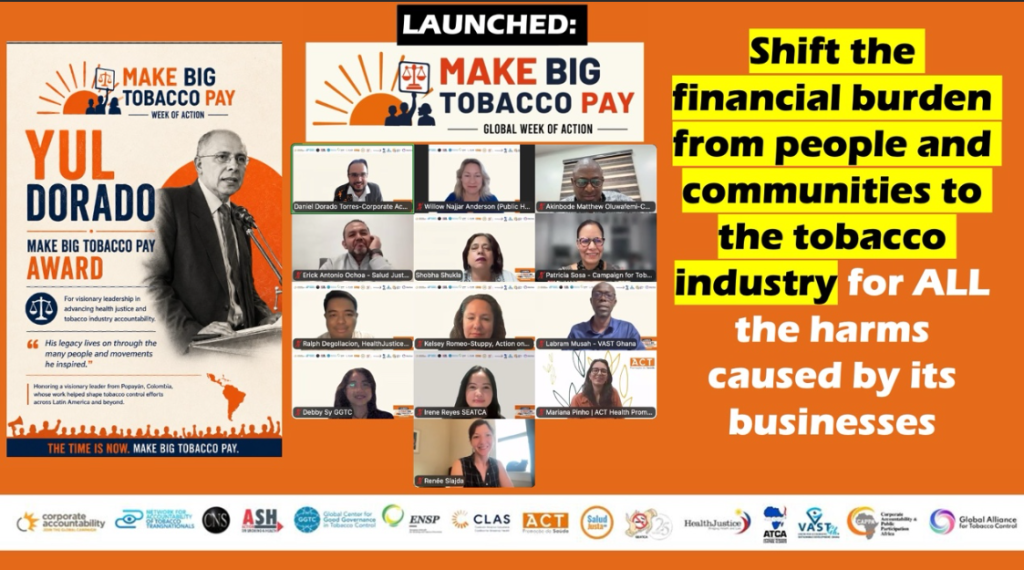
“How can we allow the tobacco industry to fill its coffers while we, the people, have to empty our pockets to fend for and suffer all the harms the tobacco industry has caused? It is high time to shift the financial burden from people and communities to the tobacco industry for ALL the harms caused by its businesses,” said Shobha Shukla while opening the launch of the historic Global Week of Action to Make Big Tobacco Pay.
“No matter where we live or what we look like, everyone deserves to lead a healthy life. But the tobacco industry sells dangerous and deadly products at huge profits. Meanwhile, we all pay – with our lives, our taxes, and our environment,” said Daniel Dorado, tobacco campaign director at Corporate Accountability and organizer of the Make Big Tobacco Pay coalition (and a winner of this year’s prestigious World Health Organization (WHO)’s World No Tobacco Day Award).
Many people know that tobacco use kills approximately 8 million people each year worldwide and is a risk factor for many life-altering diseases, including heart disease, stroke, cancer, diabetes, and TB. Every disease and untimely death caused by tobacco and nicotine products could have been prevented. Even one tobacco death is a death too many.
But few people realize that the tobacco industry also costs society over USD $1.4 trillion every year to treat these preventable diseases and to clean up the industry’s toxic pollution. Cigarette butts, which are made of plastic, are the most littered item in the world; e-cigarette waste continues to grow; and both products leach toxic chemicals into our water and soil.
Meanwhile, tobacco corporations bring in nearly USD $1 trillion in revenue from addicting people to products they know are dangerous and deadly. That’s more than Google, Meta, and Apple combined.
“If we only clean ‘downstream,’ the industry gets profit and communities get all the pollution, clean-up costs, and health harms. “This is not an accident; it is a business model – one that privatizes the profits and socializes the harm,” said Willow Najjar Anderson, Senior Staff Attorney at the Public Health Law Center.
“Tobacco corporations cheat us financially – whether we use their products or not. The industry can only be profitable because it has foisted the costs of its business onto the people and our governments,” said Jaime Arcila, senior researcher at Corporate Accountability.
“Fortunately, we have a powerful tool to make Big Tobacco pay for its harms: the global tobacco treaty,” he added.
183 nations worldwide have ratified the legally binding World Health Organization Framework Convention on Tobacco Control (WHO FCTC). Signatories are committed to holding the tobacco industry legally and financially liable for its harms (Article 19) and preventing industry interference in health policymaking (Article 5.3).
Advocates emphasized that Article 19 provides many ways to achieve liability beyond large-scale litigation, as many countries lack judicial systems that are adequate to hold transnational corporations liable.
“We have made a lot of progress on WHO FCTC Article 19 on liability at the last two global tobacco treaty meetings (COPs), and this Global Week of Action is so important in keeping the momentum going before the next one,” said Kelsey Romeo-Stuppy, Managing Attorney, Action on Smoking and Health (ASH).
“The Brazilian government is trying to implement the FCTC Article 19 through a lawsuit against the two largest cigarette manufacturers in the country and in the world and their national partners. This action was proposed in 2019 by the Attorney General’s Office, and it aims to reimburse the public health system for the expenses of the treatment of 27 diseases related to smoking. “It is a very important lawsuit not only for us in Brazil, but for the world, as the final decision will positively or negatively impact other countries,” said Mariana Pinho, Tobacco Control Coordinator at ACT Promoção da Saúde (ACT Health Promotion), Brazil.
“We need to make Big Tobacco pay through any means necessary, litigation, regulation, sanctions, and anything else we can do to build a healthier community where people come first,” said Akinbode Oluwafemi, Executive Director of Corporate Accountability & Public Participation Africa (CAPPA).
During the Week of Action, advocates will be calling on their governments to advance liability measures at both the national and international levels. The week kicks off with an online launch on June 1, followed by in-person and virtual actions in Mexico, Brazil, the United States, the Philippines, Nigeria, and Ghana. Partner organizations are also circulating a petition to Make Big Tobacco Pay, which already has nearly 40,000 signatures worldwide.
“Finding the tobacco industry at fault means very little if the penalties amount to peanuts compared to the scale of harms caused by its businesses. Our goal should always be clear: that we want to make the tobacco industry pay for the full costs of its products, both on health and the environment. We shouldn’t stop at exposing the industry’s wrongdoing; we must make sure there is compensation and remediation,” said Debby Sy, Global Center for Good Governance in Tobacco Control (GGTC).
“There are many ways to hold the tobacco industry accountable. We have been in countries exploring environmental law, which is cutting-edge and has a lot of potential in countries with judiciaries that are not particularly strong to make Big Tobacco pay for its actions,” said Patricia Sosa, Regional Advocacy Director for Latin America and the Caribbean, Campaign for Tobacco-Free Kids.
Yul Dorado makes big tobacco pay an award
Corporate Accountability also announced the creation of the Yul Dorado Make Big Tobacco Pay Award to recognize visionary leadership in advancing health justice and tobacco industry accountability. Beginning next year, the award will honor outstanding efforts by governments, civil society, and advocates who are helping advance the global movement to make Big Tobacco pay for the harms it causes.
Make big tobacco pay.
It is time for accountability, and for the tobacco industry, that is, Big Tobacco, to pay for ALL the harms they have caused to human life and our planet.
Make Big Tobacco Pay is a campaign led by Corporate Accountability, in coalition with civil society and NGO groups from around the world, including Network for Accountability of Tobacco Transnationals (NATT), CNS, Action on Smoking and Health (ASH), Global Center for Good Governance in Tobacco Control (GGTC), European Network for Smoking and Tobacco Prevention (ENSP), Coalición América Saludable (CLAS), ACT Promoção da Saúde (ACT), Salud Justa MX Mexico, Southeast Asia Tobacco Control Alliance (SEATCA), Health Justice Philippines, African Tobacco Control Alliance (ATCA), Vision for Accelerated Sustainable Development (VAST) Ghana, Corporate Accountability and Public Participation Africa (CAPPA), and Global Alliance for Tobacco Control (GATC).
Let us hope that the Global Week of Action to make Big Tobacco pay results in urgent action by the governments at the domestic level, as well as stronger progress on Article 19 of FCTC.


