
 0
0
 0
0
By Shobha Shukla
Around the world, millions of women and girls are denied equal rights to education, employment, pay, inheritance, and land rights – the list is endless. Even by law, women have fewer rights than men. Globally, women hold only 64% (which is less than two-thirds) of the legal rights enjoyed by men. In other words, laws that protect and guarantee the human rights to safety, freedom, and opportunities are biased against women and girls.
In fact, according to the most recent report from the United Nations Secretary General, the gender justice gap is even wider in actual practice. On top of that, weak enforcement of even the existing laws hardens the barriers – including discrimination, deep-seated structural inequalities, violence, abuse, and underrepresentation in legal systems – that women and girls already face in accessing justice.
UN Women defines justice as a means to restore rights, dismantle systematic discrimination, build trust, and prevent future abuses by increasing accountability. Justice recognizes women’s and girls’ rights, dignity, voice, and freedoms and protects them. When justice systems fail to protect women and girls, violence and discrimination spread – and impunity tells perpetrators that the rule of law does not matter.
It is no great wonder that the priority theme on which the 70th Session of the UN Intergovernmental Commission on the Status of Women (CSW70) focused this year was ensuring and strengthening access to justice for all women and girls.
Women and girls face numerous obstacles: legal, financial, geographical, and institutional barriers that hinder their access to gender justice, bodily autonomy, sexual and reproductive health services, and mechanisms for redress and reparation. The Women’s Rights Caucus recently hosted a press conference around CSW70 to discuss these issues. The conference was co-convened by the Asia Pacific Forum on Women, Law and Development (APWLD); the African Women’s Development and Communication Network; Fòs Feminista; Outright International; the Young Feminist Caucus; the Global Center for Health Diplomacy and Inclusion (CeHDI); and CNS.
Several feminist leaders shared their concerns about the growing gender biases impacting systemic gender discrimination that remains deeply embedded in all societies. The barriers multiply further for women – including migrant women, women of color, women with disabilities, women living in poverty, women of diverse gender identity, or women affected by conflict – facing intersecting forms of discrimination.
Factors abetting injustice
Maluseu Doris Tulifau, a feminist from Samoa, shared the tribulations of women of the Pacific region in seeking justice. She said, “From a Pacific perspective, justice is not experienced through a single system. Women navigate a continuum of justice systems: formal courts, customary governance, faith-based authority, and family negotiation. For most women, particularly in rural, remote, and outer island communities, customary and community-based justice mechanisms remain the primary entry point for justice. They are geographically closer, faster, and less costly than formal courts.”
“But women are also clear-eyed about the limitations. In cases of family violence and sexual violence, customary processes often prioritize reconciliation, compensation, or restoring harmony between families over women’s safety and accountability for harm. Family reputation, church authority, and social hierarchy frequently pressure survivors to remain silent about violence. This cultural silence continues to protect perpetrators,” added Doris.
Doris also shared the structural inequalities and challenges – like climate change, economic inequality, digital harassment, and exploitation – which the Pacific women have to confront while navigating systems of justice.
“Climate change, rising seas, displacement, and extreme weather conditions are intensifying poverty, insecurity, and violence against women and girls. Climate change is not only an environmental issue – it is a justice crisis. Without economic security, women cannot leave violent situations or pursue legal action. Across the Pacific, decades of neoliberal economic policies have weakened the very systems that women rely on for protection and justice. Digital harassment, exploitation, and surveillance are increasingly affecting women and girls across the region,” said Doris of Samoa.
Furthermore, Pacific voices continue to be structurally excluded at the global level. Small island states and grassroots organizations face visa barriers, funding limitations, and structural exclusion from global spaces like CSW. Representation matters to achieving real justice, feels Doris.
For Maitree Muzumdar, co-convener of the Young Feminist Caucus and the Women’s Rights Caucus, “gender inequality is rooted in economic exploitation, militarism, and historical injustice as recognized in the Beijing Declaration 1995 and its Platform for Action as well as in the International Conference on Population and Development (ICPD) Programme of Action 1994.”
Maitree said, “Debt burdens and austerity frequently limit public spending, resulting in underfunded courts, limited legal aid services, and reduced access to essential services and remedies. Without addressing these structural economic constraints, commitments to strengthen access to justice remain difficult to realize in practice.”
“Many a time, governments themselves are responsible for serious human rights violations through misuse of security laws, policing, and impunity of armed forces used to justify repression and criminalization against communities demanding justice,” she added.
The situation in Asia is no better.
Agrees Asel Dunganaeva, a human rights activist from Kyrgyzstan, that across Asia, debt-driven development, austerity policies, and economic inequality are diverging public resources away from healthcare, education, and social protection, making justice even more inaccessible for women and communities already living on the margins.
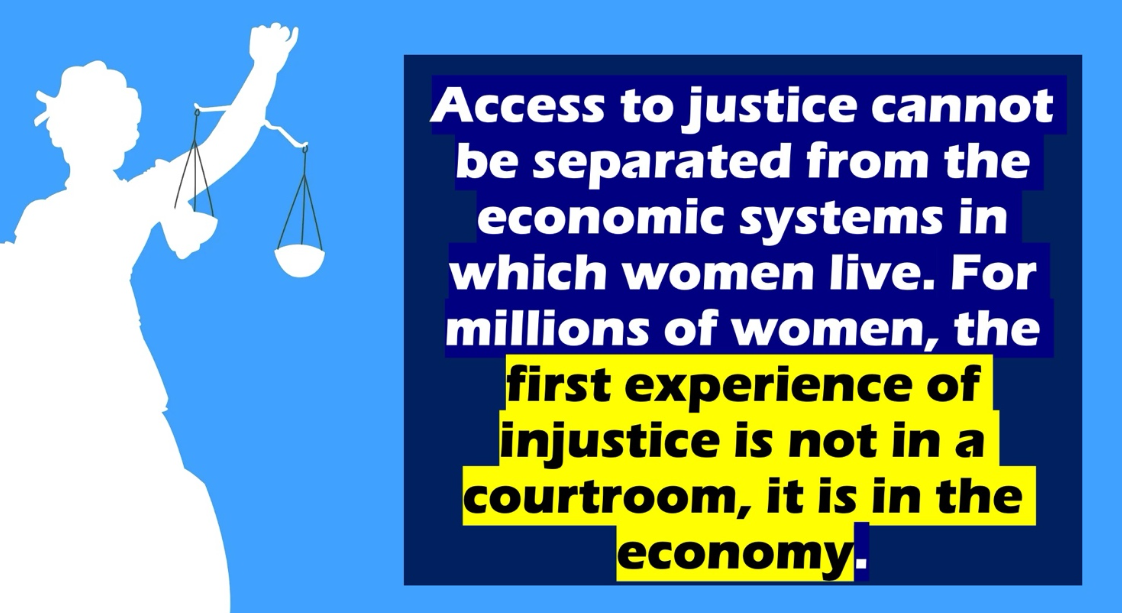
Access to justice cannot be separated from the economic systems in which women live, says Asel.
For millions of women across Asia, the first experience of injustice is not in a courtroom; it is in the economy. Economic policy is often presented as neutral and technical, but economic decisions are essentially political choices,” she said.
Asel shared the structural, social, economic, geographic, and institutional barriers to justice faced by marginalized women and girls in all their diversity across Asia: women in rural, remote, and maritime areas; indigenous women; women with disabilities; sex workers; migrant workers; marriage migrants; refugees; women living with HIV; and women from gender-diverse communities.
Weak implementation of laws
“Justice systems often exist in law but not in lived experience. Women may have rights on paper but face stigma, fear of retaliation, lack of legal aid, and economic dependency that prevents them from claiming those rights. Across Asia, justice systems remain inaccessible, under-resourced, and attacked by patriarchy and inequality. Discriminatory laws and colonial legal legacies continue to control women’s bodies, restrict sexuality and identity, and criminalize marginalized communities,” rued Asel.
Even when legal protections and reforms exist, implementation remains weak. In Central Asia, even though legal protections against domestic violence have expanded in five countries recently, we are witnessing a disturbing rollback of women’s human rights across the region, added Asel.
The way forward
There was a common consensus that justice demands structural transformation, redistribution of power and resources, demilitarization of economies, and decolonization of global governments. It requires dismantling systems of power that perpetuate inequality and promoting repair and recompense for victims, the community, and relationships. Without transforming these structural conditions, access to justice cannot be realised.
Justice also demands stronger accountability for human rights violations committed by both state and non-state actors. Women and girls are often the first responders to violence and the strongest advocates of justice. Nevertheless they remain chronically underfunded and excluded from decision-making spaces. Justice for women and girls can’t be achieved if those most affected are excluded from the spaces where laws, norms, and global commitments are made.


