 0
0
 0
0
By Shobha Shukla
The World Health Assembly (WHA) is the supreme decision-making body of the United Nations (UN) health agency, the World Health Organization (WHO), and is composed of health ministers from 194 countries. The 79th WHA will be held from 18 to 23 May 2026 at the UN in Geneva. With growing anti-rights and anti-gender backlash, several gender equality and global health activists are calling on health ministers who will meet at the intergovernmental WHA79 to protect gains made on #HealthForAll as well as advance progress towards gender equality.
“It is a human rights imperative to counter anti-rights and anti-gender pushbacks while we accelerate progress towards achieving gender equality and the human right to health. Both gender equality (including SDG-5 targets) and the right to health (including SDG-3 targets) are inseparable, inalienable, and indivisible. While all countries promise to deliver on the WHA79 agenda and #HealthForAll, would they also act to bridge the gaps in progress on gender equality? Governments cannot deliver on health for all while abetting anti-rights and anti-gender regressive agendas,” said Shobha Shukla, Coordinator and Host of SHE & Rights.
The WHA79 agenda has a few instances of reference to gender equality-related agenda items, such as “Strategy for integrating gender analysis and actions into the work of WHO,” but this is clearly not enough to ensure we deliver on Universal Healthcare Coverage (UHC) by 2030,” added Shobha.
Noted human rights defender Matcha Phorn-in demanded that gender equality and the human right to health must be central to all development policies, investments, and projects. Matcha, who serves as executive director of Sangsan Anakot Yawachon, was speaking in the inaugural SHE & Rights Live session at the Women Deliver Conference 2026.
She also calls for full recognition of indigenous peoples and their rights, as well as implementation of free, prior, and informed consent in all development projects. There must be accountability for human rights violations and environmental harms caused by these projects and business activities.
Matcha also demanded another non-negotiable: an inclusive and non-discriminatory healthcare system and public services, which must include full access to gender-affirming care as well as sexual and reproductive health and rights services, where no one is left behind. We must move beyond symbolism when it comes to legal and policy reforms so that all people in all their diversities can have full access to public health services and social protection in a rights-based manner.
“With the current right-wing uproar, we need to remember that we demand sexual and reproductive health, rights, and justice, and not just reproductive health. We also need to decolonize development finance, have radical inclusivity, and pivot intersectionality,” said Dr. Harjyot Khosa, a gender justice and global health advocate.
Long walk to healthy ageing
One of the agendas at WHA 2026 is a report on the Decade of Healthy Aging 2020–2030. A special SHE & Rights session at the Women Deliver Conference 2026 focused on a currently being drafted legally binding UN treaty (legally binding instrument) for the human rights of older persons, with a focus on women, indigenous peoples, persons with disabilities, and other marginalized and vulnerable communities, with a life cycle approach.
“Longevity is one of humanity’s greatest achievements. Yet the promise of longer life is too often accompanied by persistent gaps in the protection of human rights. Instead of celebrating older age, most people fear it, and ageism fuels this fear. Ageism lurks. I, being an older person myself, was among those with lived experience who were invited to the historic first-ever drafting of this treaty in Geneva in February 2026,” said Shobha Shukla, founder and leader of Development Justice for Older Persons (DJ4OP) and host of SHE & Rights.
While opening the IGWG meeting, Nada Al-Nashif, UN Deputy High Commissioner for Human Rights, who, like Shobha, is a senior citizen herself, had said that “meaningful participation is essential.” Older persons themselves, in all their diversity, including older women, older persons with disabilities, and those belonging to indigenous peoples, minorities, and rural communities, must be actively engaged in this process. Civil society organizations, national human rights institutions, and independent experts bring indispensable experience, data, and insight. An inclusive and transparent process will strengthen both the legitimacy and the quality of the outcome.”
“Ageism is one big elephant in the room. It includes harmful norms, stereotypes, narratives, and tropes against older persons. It affects women more than men, and the less educated more than the better educated. To be a gender-diverse person or a woman or one with a disability and to be elderly is double trouble in many countries, including India, more so if you stand up against ageism and do not fit into the norm. Subtle nuances of ageism abound in every nook and corner and lurk where you least expect them: homes, society at large, workplaces, industries, healthcare facilities, media… the list is endless,” said Shobha Shukla.
In Argentina, social protection for older persons is fragile as it often lacks optimal resources, especially for healthcare, said Dr. Mabel Bianco, a noted feminist leader and founder of the Foundation for Studies and Research on Women (FEIM) and 2024 Director for Latin America and the Caribbean, International Federation of Ageing (IFA). Dr. Mabel agrees with Shobha Shukla that harmful stereotypes like ageism block access of older persons to sexual health services.
Ageism lurks
Dr. Pam Rajput, Emeritus Professor, Panjab University, India, and former Chairperson of the Government of India’s High-Level Committee on the Status of Women, shared her personal testimony of duty travels when she, being a senior citizen herself, needs to travel via airplanes. One question she is frequently asked is ‘if she is traveling alone,’ which stinks of harmful stereotypes that make it difficult for many to comprehend that older people, especially women, may also travel for work. Unless we normalize economic rights along with gender, social, and cultural rights of older persons, especially women, we will not be able to address ageism and the challenge that population aging poses.
Around the world, millions of girls and women live with uncertainties about whether they will be safe, heard, and protected. This is a reality we must confront. Globally, 1 in 3 women experiences physical or sexual violence in her lifetime. But behind these numbers are women who remain unseen, older women, women with disabilities, or girls and women in political situations who are often excluded from data and, therefore, excluded from protection,” said Dr. Imran Pambudi, director of Vulnerable Groups Health Services, Ministry of Health, Indonesia. Older persons, ending violence against women, and persons with disabilities are some of the focus areas of Dr. Pambudi.
“In Indonesia, the number of women who face violence increased by 14% in 2024 (330,000 women faced violence that year). One-third of these cases were of sexual violence. It is important to recognize that around 90% of rape cases are not reported, which means that what we see in data is only the surface of a much deeper reality. We must realize that violence affects women at all stages of life.
In Indonesia, around 12% of the population are older persons (~35 million). By 2045, ~20% of the Indonesian population is expected to be older persons. This means that protecting the rights, health, and dignity of older persons is not a ‘future concern’ but a present responsibility,” said Dr. Pambudi. “Persons with disabilities are twice as likely to face health problems.”
In Indonesia, since February 2025, over 7 million older persons have already undergone free health screening provided by the government.
“Protecting rights must go hand-in-hand with ending gender-based violence across the life course. Violence persists where systems fail to protect, where voices are not heard, and where inequalities are left unaddressed. The health sector must play an important role not only for treatment, care, and support but also for prevention and survivor-centered response,” said Dr. Pambudi.
Ageism is propelled by the media, too.
“Women over 60 years old must be seen, valued, and respected,” said Rita Widiadana, a senior citizen as well as a senior journalist and editor from Indonesia. Rita has earlier served a long tenure as editor of The Jakarta Post. She is also an Advisor for Development Justice for Older Persons (DJ4OP).
“It can be challenging to live as elderly persons in Indonesia. For most women over 60, the challenges are even harder. The society and the media, as well, often associate older men with wisdom and rich experience, but elderly women are persistently portrayed as caregivers who are vulnerable and frail rather than independent and empowered individuals (and with wisdom and rich experience too). It is unfortunate that media depictions of elderly women negatively affect societal perceptions that contribute to various discriminations in families, in the workplace, and in daily life,” said Rita Widiadana.
“It is high time for us to recognize the social and economic contributions that they make to their families and communities and to be included in a large variety of national development programs,” she asserted.
Development justice needs to be a life-course justice.
Margaret Young, Founder of Age Knowble and past Chair of the Global Alliance for the Rights of Older People (GAROP), said that “development justice is strongest when older persons are recognized, included, and empowered.” We speak often of gender justice, youth opportunity, and equity. Every young person is moving through the life course. Every girl may one day become an older woman. That means the rights of older women are not separate from the rights of younger women. They are part of the same life course story. Advancing the rights of older women strengthens gender justice across the life course. Developmental justice also needs to be life course justice. Many inequalities accumulate across life and become sharper in older age. Lower earnings, unpaid care, widowhood, violence, isolation, and barriers to health and participation.”
“We are living in an age of aging with a fast-growing number of older people. Life expectancy has increased significantly in most settings over the past few years. Japan has nearly 100,000 people aged 100 or older, the highest in the world, with women comprising roughly 88% of this population. By 2050, the population of persons above 60 years of age is projected to grow to 2.1 billion (nearly one-fifth of the total global population),” said Shobha Shukla of Development Justice for Older Persons (DJ4OP) and SHE & Rights.
“We, the elderly, are not asking for mercy. We are asking for our long-overdue rights. We need to be recognized, not as burdens, but as rights holders and as vital contributors to families, communities, economies, and public life. We do not need shelter homes, but the right to live a fulfilling life. Ageism and gender inequality must end with us,” said Shobha Shukla.
Abortion rights are human rights.
Safe abortion is healthcare. Abortion rights are human rights. “Every person, regardless of where they were born, what they earn, who they love, and how they identify, deserves the right to make decisions about their own body. That is not a political position. This is the foundational premise of human dignity,” said Debanjana Choudhuri, an independent gender justice activist.
“I have worked with communities and states where contraceptive prevalence is devastatingly low. I have worked in countries where abortion is criminalized so completely that even miscarriage becomes grounds for an investigation. I have led coalitions, shaped policy, and navigated the most hostile legal environments in our struggle for safe abortion rights. And I can tell you that the battle is far from over. Making abortion illegal does not make abortion rare. It completely makes it dangerous. It makes it deadly. And it makes it a privilege of the wealthy,” said Debanjana Choudhuri at the Women Deliver Conference 2026.
“Safe abortion is a human right, and it is not conditional, it is not a medical concession, and it is not a last resort,” said Debanjana Choudhuri. “Abortion seekers have the choice, and the choice has to be trusted and is non-negotiable. When a right becomes inconvenient to the powerful, it is no longer a right; it becomes a permission, and permissions can be revoked.
Unfortunately, many policies that legalize abortion in many countries seem like permission, as we always live in the fear that they can be revoked because they are conditional. We are at a moment globally where those permissions are being revoked in legislation, in court rulings, and in “quiet defunding” of services that people depend upon. And the response to that moment cannot be silence or compromise. It must be clarity. Safe abortion is a human right. Choice is an expression of dignity. And every person across every dignity, every identity, every geography, and every circumstance deserves both.”
Philippine abortion laws are among the most restrictive in the world.
In 2012, the Philippines passed the landmark Responsible Parenthood and Reproductive Health Act. The passage of this law was not just a legislative victory for the women’s rights movement but a culmination of a grueling struggle for decades to reframe reproductive health as a human rights and social justice issue. However, despite these hard-won victories, sexual and reproductive health and rights remain under-prioritized in the national agenda and even within the broader movement. Abortion rights are often treated as a fringe and contentious topic. That is why in 2015, PINSAN (Philippine Safe Abortion Advocacy Network) was born out of confronting the uncomfortable truth that while the Responsible Parenthood and Reproductive Health Act of 2012 was a landmark, it had to eventually leave the abortion rights issue at the negotiation table. We at the PINSAN network see the imperative to keep that conversation going and to center abortion rights issues on our right to bodily autonomy and right to compassionate and nonjudgmental health care. No one should be punished for accessing care. Struggle is going on because the Philippines’ abortion laws are among the most restrictive in the world,” said Pauline Fernandez, Coordinator of the Philippine Safe Abortion Advocacy Network (PINSAN), at the Women Deliver Conference 2026.
“The revised penal code considers abortion to be a criminal offense punishable for care providers who perform abortions and persons in need of abortion care who undergo it. The law does not explicitly permit it under any circumstances. And despite it being criminalized, abortion remains a widespread and urgent reality in the Philippines. Data shows that in the country, upwards of a million women undergo abortions annually. This especially affects girls and women from vulnerable and underserved communities. Because of unsafe abortion-related complications, up to 3 women die every day in the Philippines. Each year, Filipino women resort to clandestine and unsafe methods to end their pregnancies, proving that restricting abortion does not stop it. Instead, it drives the practice underground, putting women’s health and lives at risk,” said Pauline Fernandez.
“While the law technically allows for postabortion care, this criminalisation creates a climate of fear. Women suffering from complications often delay seeking help because they do not want to be arrested. Healthcare providers bound by their own perceptions on abortion and bound by their fear of prosecution may threaten or delay treatment for these women, turning hospitals into sites of interrogation rather than that of healing,” she added. “These laws validate social stigma, forcing women to carry the trauma of unsafe procedures in silence. And the silence prevents them and us from advocating for our rights effectively and kind of insulates the state from accountability for this public health disaster.”
The Philippines’ Adolescent Pregnancy Bill was blocked, too.
“The movement against abortion rights in the Philippines is often dismissed as purely religious and conservative. But in reality, it’s a sophisticated political machinery that weaponises culture and faith to entrench this inequality. Given that abortion rights and issues disproportionately affect women, it reinforces this need to control women’s bodies and women’s decision-making and holds this systemic barrier to reproductive justice. So, we see this in the halls of Congress and Senate, where, for example, recently the passage of the Prevention of Adolescent Pregnancy Bill was blocked because it presented language on sex, gender, and reproductive health that is not palatable to some, saying that ‘it would hypersexualize children.’ Government agencies that have expressed support for the decriminalisation of abortion are threatened with their budgets being slashed. When more progressive lawmakers, for example, show support for women’s reproductive health issues, receive tons of backlash or red tags, or get heat from fellow lawmakers,” said Pauline.
“We see so-called ‘pro-life’ movements take up space online or mass mobilize, centered on disinformation and fear-mongering. We see hospital staff interrogate and shame patients. We see abuses of consensus or objection clauses where doctors refuse to provide even legal reproductive services like contraceptives or post-abortion care services, and as mentioned earlier, those are usually framed through the guise of religiosity or care for Filipino values. This narrative is a calculated tool that forces women to carry the disproportionate burden of reproduction while stripping us of our fundamental right to choose and framing this abortion as a ‘moral crime’ rather than a healthcare necessity,” said Pauline Fernandez of PINSAN.
“The state and its conservative allies use faith and values as a shield to ensure that our bodies remain public property rather than our own. There’s also growing international backlash that isn’t happening in a vacuum because it creates a direct ripple effect in the Philippines. This also impacts us as international donors withdraw their funding and support from local programs on sexual and reproductive health and rights and other women’s and gender justice issues,” added Pauline of PINSAN.
US withdrawal and anti-rights pushbacks
The US withdrawal from different international organisations, for example, is not just a diplomatic move. It is also a signal from a global superpower that ‘it is okay for governments to de-prioritise gender equality,’ so governments may feel less pressured to comply with international treaty obligations. We saw this in action during the Philippines’ recent Universal Periodic Review (UPR) at the UN Human Rights Council: despite receiving direct urgent recommendations to decriminalise abortion and pass the equality law, the Philippine government did not accept these recommendations, dismissing them as contrary to our so-called national culture and religious values,” said Pauline.
PINSAN’s campaign calls to decriminalise abortion in the Philippines. This means that abortion will no longer be treated as a crime. “This is different from legalisation, which means that a law is passed that explicitly allows and defines abortion in certain times, lifetime periods, or conditions. However, if criminal laws remain in place, people can still be punished if they fall outside of the expressed legal grounds. And what we want from the decriminalisation campaign is to remove these abortion provisions from the revised penal code, ensuring that no one goes to jail for assisting with supporting, performing, or providing abortion care. All of this is in line with the belief that abortion care is an essential form of healthcare and that healthcare should not be a crime,” said Pauline.
“One of the major gains in our almost a decade of pushing for this campaign is that last year, around International Safe Abortion Day 2025, we officially and formally launched the Decriminalise Abortion Now Network. From 10 organisations initially, now this movement is led by 130 organisations and individuals with over 30,000 signatories on the petition to decriminalise abortion now,” said Pauline of PINSAN. “This movement has also helped shatter the isolation because earlier talking about abortion in the Philippines was taboo and controversial; we got judged and risked being prosecuted legally or socially. With brave advocates openly supporting the call to decriminalise abortion now, it has transformed the very nature of our struggle by shattering the isolation that conservatives earlier used to silence us. We are moving from a position of vulnerability to one of collective power. This movement proves that despite the threats and stigma, there is a critical mass of Filipinos ready to stand on the side of history and to ensure that no one has to fight for their bodily autonomy alone.”
Sunshine, a film on Netflix, had consulted PINSAN in the initial stages. This film stars a Filipino actress and tells the story of a young girl who sought an abortion clandestinely. While emphasizing power and choice, it opened the door to how to talk about abortion with a wider audience. “We have also drafted a proposed decriminalisation of abortion bill, which has engaged champions within the legislature and other government agencies,” said Pauline Fernandez of PINSAN.
Abortion is legal in Nepal, but not equitably accessible to all.
“Safe abortion is legal in Nepal but not equitably accessible to all, even now,” said Kalpana Acharya, Editor-in-Chief of Health TV Online and Host of the famous Health First Podcast. Kalpana narrated an incident from a week before she came to speak at Women Deliver 2026 in Australia. A 29-year-old woman (who was a health worker) lost her life due to unsafe abortion. Her husband is also a health worker. But unfortunately, she went to seek an abortion in an unregistered clinic due to social stigma. “We need to bridge the gap between policy and implementation,” said Kalpana Acharya.
Transgender rights are human rights inalienable from gender justice.
“Due to the historic struggle for transgender rights waged by gender-diverse communities over several decades, we have seen some progress in some contexts and countries. But with rising anti-rights and anti-gender pushbacks, a lot of such progress is threatened or is being rolled back. This regressive rollback of rights is so deeply disturbing and absolutely unacceptable. With 56 months left to deliver on SDG-5 on gender equality, we will fail if goals and targets exclude transgender people and other persons in all gender diversities,” said Shobha Shukla, coordinator of SHE & Rights, while speaking at the Women Deliver Conference 2026.
“The struggle for transgender rights in the Asia Pacific has not been a straight line,” said Hua Boonyapisomparn, International Trans Fund Program Officer for South, East, Southeast Asia, and the Pacific, who has been a part of the transgender rights movement in the region for over 20 years now.
Hua reflected on the popular opinion about transgender people being highly visible in Thailand. “But visibility is not the same as enjoying human rights. Being seen is not the same as being protected. Being accepted is not the same as being accepted in ‘some spaces’ and is not the same as having dignity in law, healthcare, education, work, and everyday life.”
One piece of good news from Thailand is that the government has approved THB 145 million (US$4.3 million) to cover free gender-affirming hormone and counseling therapy for over 200,000 transgender people. “Credit goes to the collective movement for transgender rights as well as for the human right to health,” said Hua. “Gender-affirming hormone is not cosmetics or a beauty product but is necessary for our health.”
The Transgender Wellbeing Charter was launched on 31st March 2026. Thailand’s national health commission office referred to it as Thailand’s first national health charter on transgender wellbeing and a step forward to national standard practices for gender equality and social inclusion,” said Hua.
Hua commended equitable partnerships between government and communities where people, instead of being merely beneficiaries, partner with policymakers to shape policies collectively. Thailand is one of the countries without legal gender recognition. “In India, amendments made to the transgender law in 2026 were strongly opposed by transgender communities as well as other human rights crusaders. This law increases the state’s control over transgender people’s identities by requiring official checks and approval,” said Hua.
“Very recently, the current government has sort of gone back to its very progressive transgender rights law that had ensured the lives of transgender people are protected, just not in terms of their identity but in terms of their betterment and well-being. It is sad to see that without even consulting the communities across the country, amendments were made to the law within a short period of time earlier this year, which has turned the tables against a particular community (transgender community),” said Simran Shaikh Bharuch, a noted transgender rights advocate in India, who was on the SHE & Rights panel at the Women Deliver Conference 2026. “Government pushed for the amendments so that all benefits as per the law go only to a subset of all communities that are included under the transgender umbrella.”
“Laws in Tonga do not provide protection against discrimination based on gender identity in employment, housing, or public services,” said Joey Joleen Mataele, Founder of the Tonga Leitis Association, Tonga. Joleen has been part of the transgender rights movement for over 30 years. “Same-sex marriages and adoption are also not legally recognized. Many transgender individuals in Tonga struggle daily with stigma.”
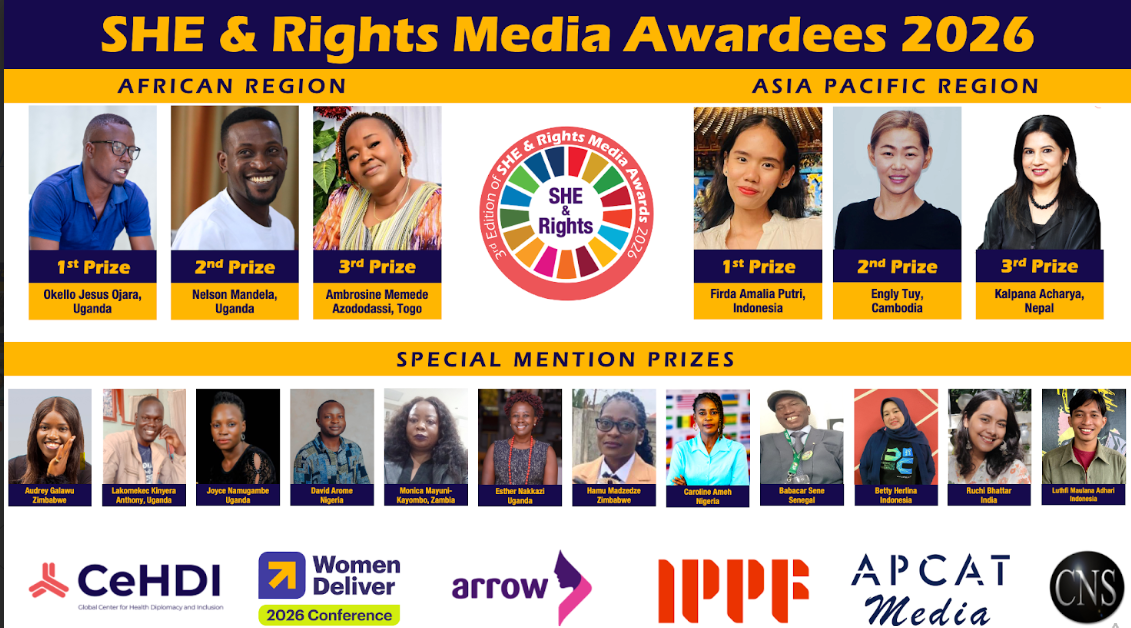
SHE & Rights Media Awards Ceremony 2026 held at Women Deliver Conference 2026 (hybrid)


