

 0
0
 0
0
By Kellia Umutoniwase
Rwanda’s district governments are largely on track to reflect the country’s climate targets in their local development plans, but big gaps remain in mining oversight and tracking climate-related losses, a study by Transparency International Rwanda (TI-Rwanda) found.
District development strategies across 10 districts give an average of 60.9% indicative support to the priorities laid out in Rwanda’s third Nationally Determined Contribution (NDC 3.0), the anti-corruption watchdog said Wednesday, a level it classifies as “likely substantially integrated.”
TI-Rwanda presented the findings at a national dialogue in Kigali on embedding NDC 3.0 into district planning. The commitment itself is ambitious: Rwanda has pledged to cut greenhouse gas emissions by up to 53% by 2035, alongside efforts to strengthen climate resilience and sustainable growth. Much of that work falls to districts, whose development strategies are supposed to turn national climate goals into local budgets and projects.
Researchers examined 10 districts, Gisagara, Ngoma, Ngororero, Nyanza, Nyagatare, Nyaruguru, Nyamagabe, Rusizi, Ruhango, and Rutsiro, looking at how well climate priorities show up in policy, planning, budgeting, sector strategies, data systems, governance, and institutional capacity.
Mining and loss-and-damage tracking lag behind.
Support was strongest on climate finance at 70% and forestry and land use at 67.5%. Agriculture and national mitigation priorities followed at 62.5% each, with water resources and health adaptation both at 60%. Disaster risk management came in at 55% and urban and settlement planning at 50%.
Mining and loss-and-damage tracking stood out as the weakest spots, with partial support of just 35% and 30%, respectively. TI-Rwanda said this points to gaps in enforcing climate-compliance rules and to the absence of solid systems for recording losses linked to climate change at the district level.
The study also found a gap between policy and follow-through; while NDC 3.0 priorities were reflected in 83% of policy frameworks and 80% of sector strategies reviewed, fewer districts had the baselines, risk assessments, budget links, or climate screening needed to actually put those priorities into practice, a shortfall the report flags as central to closing the implementation gap.
By sector, agriculture and environment scored best, at 80% each, ahead of water (63%), energy (53%), transport (48%), and urban planning (45%). Mining again brought up the rear, at just 28%.
Strong participation, weaker accountability
Government institutions dominated district planning processes, cited by 87% of respondents, ahead of civil society (73%) and the private sector (70%). Women and youth were reported as included in 82% of cases each, people with disabilities in 80%, and older people in 79%.
Even so, TI-Rwanda said citizen-driven accountability remains thin on the ground. It recommended community scorecards, easier-to-access grievance channels, and more civil society monitoring of climate spending and service delivery to close that gap.
“Climate commitments made by our government only become real when they are planned, budgeted, and delivered, especially at the local level.” TI-Rwanda Executive Director Apollinaire Mupiganyi said.
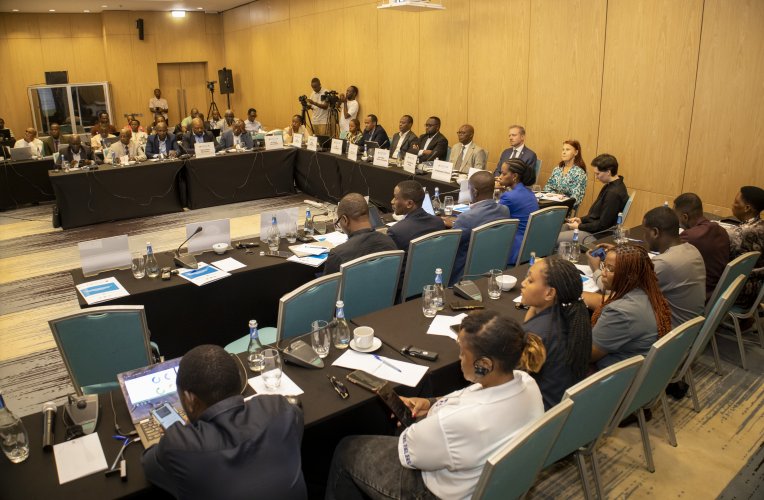
He warned that corruption in climate-funded projects, combined with weak citizen involvement in local climate governance, risks deepening the toll of climate change on communities.
What’s next?
TI-Rwanda is calling for sector-specific NDC 3.0 guidelines that build climate targets, risk indicators, and budget lines directly into sector plans, plus a standardized system for tracking climate-related losses and damages at the district level.
It also wants NDC-aligned monitoring frameworks, regular performance reviews, and a bigger role for women, youth, and people with disabilities in Joint Action Development Forums (JADF) and community climate-planning sessions, with their input written into district plans and budgets, not just noted in passing.
The report credits some existing tools for the progress made so far, including joint planning platforms, sector coordination structures, and links to national frameworks such as the second National Strategy for Transformation (NST2) and Vision 2050.


