 0
0
 0
0
Forests are a significant ecological and economic resource that sequester carbon, provide habitat for wildlife, and support livelihoods for communities, among other roles. Over the past decade, various pledges and commitments have recognized the important roles of forests and the devastating consequences of ongoing deforestation. Governments have pledged to restore forests, halt deforestation, and reverse land degradation numerous times. At COP26 in 2021, governments and companies promised to halt and reverse forest loss and land degradation by 2030.
However, these ambitious pledges are not backed by the information needed to monitor and deliver on these promises, which limits accountability. Information is lacking, including basic maps on exactly where restoration is happening. And in the years since these pledges were made, their impact has not been adequately monitored, leaving a lingering question of how much progress is being made. Among other challenges, the lack of consistent definitions, data sources, reporting frameworks, and baselines has made it difficult to hold pledge makers accountable. A globally consistent approach is needed to follow the progress, or the lack thereof, on the pledged targets to answer the urgent question: Is the world on track to stop deforestation and meet forest restoration targets?
The Global Forest Review’s Beta Targets Tracker aims to address this information gap by reporting progress using standardized definitions and geospatial data around two measurable global targets that represent the distillation of multiple global forest pledges:
- End deforestation by 2030, tracked by measuring a proxy for deforestation against a baseline average deforestation rate from 2018 to 2020.
- Restore 350 million hectares (Mha) of lost and degraded forests by 2030, tracked by measuring tree cover gain against the area of tree cover in the year 2000 as a proxy for restoration.2
The Tracker assesses whether the global community and regions critical for achieving these targets are on track, off track, or moving in the wrong direction. See the FAQ for more information about how the Tracker complements the Forest Declaration Assessment and other forest monitoring efforts.
Global Target: End deforestation by 2030
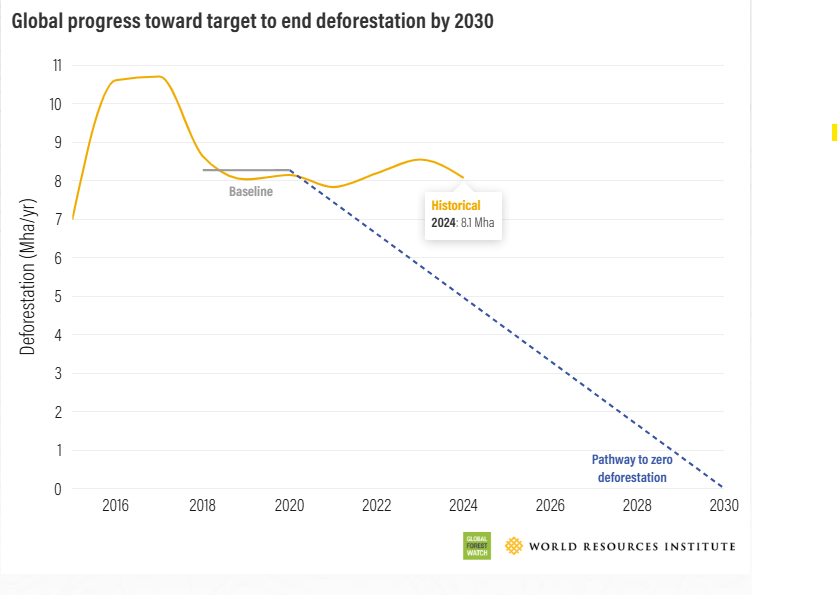
Off track: We are not on track to end deforestation by 2030
In 2024, global deforestation persisted despite needing a 10% annual reduction each year from 2020 to 2030 to reach zero deforestation by 2030, or a 20% reduction each year from 2025. The global deforestation rate in 2024 was 2% lower than the baseline from 2018-2020 but 63% higher than the rate needed to achieve zero deforestation by 2030. We have made almost no progress in the four years since the baseline rate and are thus off track to meet this target. Learn more about why deforestation continues and what can be done about it.
How we measure deforestation
Deforestation is the conversion of natural forest cover to new, non-forest land uses. Our tree cover loss data3 includes some forms of loss that do not meet this definition of deforestation, so we use a subset of tree cover loss as a proxy to better meet this definition. Specifically, we use tree cover loss where the dominant driver of loss is shifting cultivation within humid tropical primary forest, as well as all loss driven by permanent agriculture, hard commodities, and settlements and infrastructure. See the FAQ for more details on measuring deforestation.
Other relevant indicators include the loss of humid tropical primary forests and global tree cover loss, which show a 74% increase and 19% increase, respectively, in 2024 relative to the baseline average level of loss from 2018-2020. Both rates are increasing and well above the baseline rate, which also suggests we are nowhere near the reductions required to end deforestation by 2030. The deforestation proxy and the two additional indicators all show that the rate in 2024 fell short of the 10% annual reduction needed to end deforestation by 2030, meaning that the off-track assessment is not simply due to a particular proxy or indicator of deforestation.
While some degradation is included in the deforestation proxy, degradation of forests is not fully tracked and accounted for by the Tracker. Forest degradation is an ongoing problem that can have significant implications for biodiversity, carbon storage, and other ecosystem services that forests provide. However, degradation is difficult to measure and track using data derived from satellite imagery. Part of this is due to the difficulty of defining it, and although a number of definitions exist, they are not easy to match to metrics derived from satellite imagery. Better monitoring systems are needed to track degradation to ensure that we go beyond ending deforestation by also maintaining and improving forest integrity over time. See the Forest Degradation Indicator for more information.
Global Forest Watch-Writers: Elizabeth Goldman, Katie Reytar, Sarah Carter, David Gibbs, Paige Johnson, Darby Levin, Michelle Sims, Mikaela Weisse


