
 0
 0
By Christophe Uwizeyimana
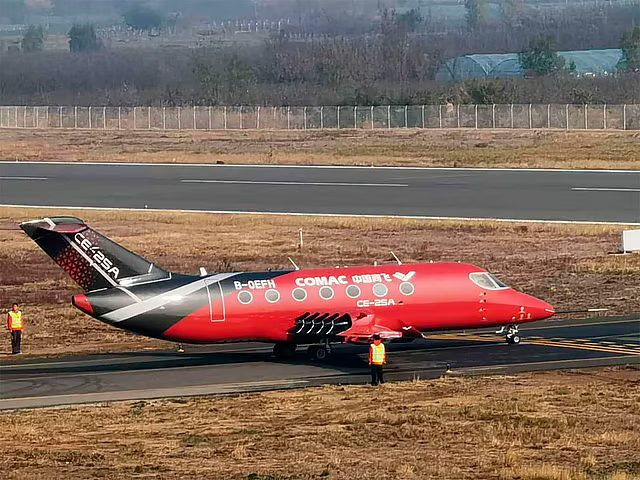
China has reached another milestone in aviation technology after its independently developed CE-25A electric passenger aircraft successfully completed its first flight with pilots on board. Link:https://x.com/ChristopheUwiz/status/2122902992265646116?a=-TJkRmH1050QWxp_2NI&s=20
The 10-tonne aircraft took to the skies on November 14, 2026, in Binzhou, Shandong Province, eastern China, carrying two pilots and a flight-test engineer.
According to the Commercial Aircraft Corporation of China (COMAC), the aircraft operated normally during the test, with all performance indicators meeting expectations.
The flight lasted 16 minutes and 38 seconds, covering a distance of approximately 60.4 kilometres. It marked the first time the aircraft had flown with people on board.
Designed to Carry 19 Passengers
The CE-25A is COMAC’s first electric commercial aircraft. It is primarily designed for short-distance journeys between cities and can accommodate up to 19 passengers.
The aircraft has a maximum take-off weight of 10 tonnes, a cruising speed of 300 kilometres per hour and a cruising altitude of 2,400 metres. According to its published specifications, it has a maximum range of 400 kilometres.
Unlike conventional aircraft that use fuel-powered engines, the CE-25A uses electric motors to power fans installed along its wings.
This technology represents an important development in efforts to explore electricity as an alternative source of power for commercial aviation.
Developed Through Chinese Collaboration
The aircraft was jointly developed by COMAC, Chinese battery manufacturer Contemporary Amperex Technology Co. Limited (CATL), Shanghai Jiao Tong University and other partners.
The project brings together expertise in aircraft manufacturing, battery technology and scientific research.
Before its first piloted flight, the CE-25A completed its first autonomous flight without people on board on February 2, 2026. It subsequently underwent 19 unmanned test flights to assess its performance and reliability.
The successful piloted flight marks another important stage in the aircraft’s development.
What Happens Next?
Despite the successful test, the CE-25A is not yet approved to carry paying passengers.
China’s Civil Aviation Administration has accepted COMAC’s application for a type certificate, which begins the formal process of assessing whether the aircraft meets aviation safety and technical requirements.
The aircraft must still undergo further testing and receive the necessary regulatory approval before it can enter commercial passenger service.
Although more work remains, the development of the CE-25A demonstrates China’s growing ambitions in electric aviation and the search for alternative technologies for future air transport.
Source: Gulf News, Xinhua News Agency and China’s Civil Aviation Administration (CAAC).


