
 0
 0
By Shobha Shukla
Antimicrobial resistance (AMR) remains a major health threat, warns the World Health Organization (WHO). With bacterial AMR associated with more than 4.7 million deaths in 2021, WHO is urging action across all sectors now and World AMR Awareness Week (WAAW 2026: November 18-24) ahead.
“AMR is one of the most urgent global health threats and development challenges. It threatens our ability to treat infections, protect animal and plant health, and produce safe food, and also has an impact on the environment,” said Dr. Jean-Pierre Nyemazi, Director a.i. of WHO’s Department of Antimicrobial Resistance and Director of the Quadripartite Joint Secretariat on AMR.
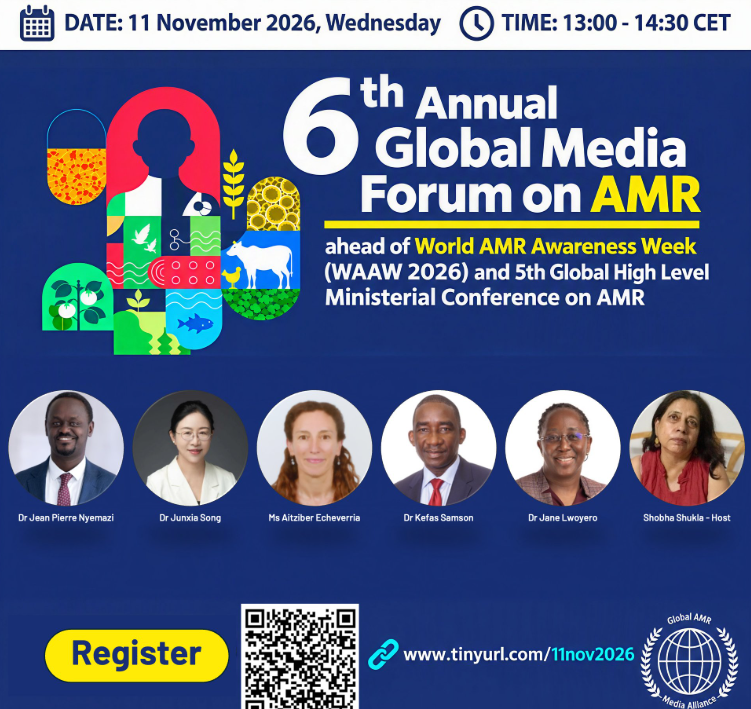
Dr. Nyemazi was speaking at the 6th Annual Global Media Forum on AMR ahead of the World AMR Awareness Week (WAAW 2026: November 18-24). WAAW theme this year is “One Health, One Action: Prevent AMR Now.”
“These are not just statistics. Behind these numbers are patients, families, farmers and communities,” Dr. Nyemazi said.
AMR is driven by antimicrobial misuse and overuse, gaps in infection prevention, poor water and sanitation, and environmental contamination.
At the 2024 United Nations General Assembly High-Level Meeting on AMR, world leaders adopted a Political Declaration and pledged to reduce AMR-associated deaths by 10 per cent by 2030, against a 2019 baseline of 4.95 million. They also committed to ensuring that at least 60 per cent of countries have funded national AMR action plans by 2030. The Political Declaration called for at least US$100 million in catalytic funding, including through the AMR Multi-Partner Trust Fund.
“However, let’s be honest. The gap between commitments and pledges versus implementation remains wide,” Nyemazi said, citing limited financing, fragmented coordination and weak surveillance.
The Quadripartite Joint Secretariat on AMR includes the Food and Agriculture Organization of the United Nations (FAO), the United Nations Environment Programme (UNEP), the World Health Organization (WHO) and the World Organisation for Animal Health (WOAH). Quadripartite agencies are helping countries strengthen governance, surveillance, responsible antimicrobial use and infection prevention.
An updated Global Action Plan on AMR for 2026–2036 has been finalised, which is likely to be launched at the Fifth Global High-Level Ministerial Conference on AMR in Abuja, Nigeria, during 6-8 December 2026.
Dr. Nyemazi confirmed that work is advancing to establish the Independent Panel on Evidence for Action against AMR (IPEA) and mobilise resources. IPEA is also likely to be launched in Abuja at the global meeting next month.
Dr. Nyemazi said global pledges must deliver results in communities and urged journalists to sustain public attention: “You make visible what is often invisible. Your accurate, evidence-based and solution-focused reporting shapes public understanding, sustains political attention and holds all of us accountable.”
“The 5th Global High-Level Ministerial Conference on AMR will review progress, address implementation challenges, and renew political commitment on AMR. However, global pledges matter only when they deliver results in communities,” said Dr. Nyemazi.
Country-level action is key as AMR commitments outpace implementation
WHO is urging countries to turn global antimicrobial resistance (AMR) commitments into funded and measurable actions, warning that inadequate financing, weak surveillance and shortages of diagnostics and health workers continue to undermine progress.
Dr. Kefas Samson, Senior Technical Officer and Lead of Multisectoral Coordination in WHO’s AMR Department, emphasised supporting governments to assess needs, cost interventions and adapt implementation to local realities and available resources. WHO is also pushing to strengthen primary healthcare and community-based services to promote infection prevention, early diagnosis and timely, appropriate treatment.
“Significant gaps persist, and progress among countries also remains uneven,” Dr Samson said. He identified inadequate financing, gaps in nationwide surveillance of AMR and antimicrobial use, weak infection prevention in healthcare facilities, limited diagnostic capacity and unequal access to quality-assured antimicrobials as major barriers. Workforce shortages compound the problem.
WHO is strengthening surveillance and monitoring to generate robust data, track implementation of the updated Global Action Plan on AMR (2026-2036) and measure progress towards the 2030 AMR targets.
Other 2030 goals include ensuring that 70 per cent of antibiotics used in human health belong to WHO’s Access group, and that 80 per cent of countries can test for priority bacterial and fungal pathogens included in the Global Antimicrobial Resistance and Use Surveillance System, said Dr. Samson.
Dr Samson described the updated Global Action Plan on AMR for 2026–2036 as “a renewed blueprint” for translating the 2024 UN Political Declaration into measurable country-level action.
The plan strengthens the One Health approach, bringing human, animal, agricultural and environmental sectors together. It prioritises prevention, cross-sector surveillance, responsible antimicrobial use, stronger laboratories, equitable access, resilient supply chains, research, innovation and sustainable financing.
“It is not just a plan, but a framework that translates the aspirations and ambitions of the political declaration on AMR 2024 into tangible actions at the country level,” said Dr. Samson.
Samson said WHO and its Quadripartite partners were developing practical guidance to help countries set priorities and accelerate implementation, with the Fifth Global High-Level Ministerial Conference on AMR in Abuja offering a further opportunity to secure measurable progress.
Without action, livestock antibiotic use could surge 30% by 2040
“FAO’s recent study, The Future of Antibiotics Use in Livestock, shows that without action, global antibiotic use in livestock could increase by nearly 30% by 2040. But with good practices on better animal health and better practices on farm management, antibiotic use could be reduced by up to 57%. This is the power of prevention,” said Dr Junxia Song, Deputy Chief Veterinarian and Chief of its One Health and Disease Control Branch, Food and Agriculture Organization of the United Nations (FAO). “Prevention must become central to the global fight against antimicrobial resistance (AMR), with farmers placed at the heart of the response.”
She said the updated Global Action Plan on AMR for 2026–2036, following the 2024 UN Political Declaration, firmly recognises the agri-food sector’s role in the One Health response.
However, translating commitments into farm-level action remains a major challenge. FAO’s assessment shows that agri-food priorities remain inadequately integrated and funded in many national AMR action plans, while nearly half of the countries have either no or only partial legislation governing antimicrobial use in animal and plant health.
FAO is addressing the gap through its 10-year initiative, Reduce the Need for Antimicrobials on Farms (RENOFARM), built around five pillars: good health services, production practices, alternatives and innovation, incentives, and connections. More than 400 partners, including over 80 FAO Member Countries, are already engaged in this initiative.
Surveillance is another priority. Through its InFARM system, FAO has engaged 80 countries in strengthening AMR monitoring across agri-food systems, helping governments improve policies and target resources. “Awareness and commitments are important, but they are not enough,” Song said, calling for stronger services, incentives, financing and capacity.
She stressed that solutions must be practical, affordable and rewarding for farmers. “By making prevention work on the ground, we can reduce the need for antibiotics while improving animal health, productivity, food safety and food security.”
Environmental neglect could undermine global fight against AMR
The global fight against antimicrobial resistance (AMR) risks failure unless countries tackle environmental pollution alongside human, agriculture and animal health interventions.
“The environment plays a key role in the emergence, transmission and spread of AMR, as per the UNEP report Bracing for Superbugs. The environment and AMR cannot be treated separately. That is the One Health concept,” said Aitziber Echeverria, AMR Coordinator, Chemicals and Health Branch, United Nations Environment Programme (UNEP).
She added: “We are moving now from recognizing the environmental dimensions of AMR to systematically addressing them. We now need implementation. As stated in the 2024 UN General Assembly Political Declaration, to tackle AMR we need to combine multi-sectoral and sector-specific actions, and the environment needs to be considered at the core, as part of the solution.
The environment plays a critical role in the emergence, transmission and spread of drug-resistant microorganisms and must become central to national AMR strategies.
“Environmental action on AMR is not an optional addition to the response. It is a prerequisite for success,” Echeverria said.
A significant milestone came in December 2025 when the United Nations Environment Assembly adopted a resolution on the environmental dimensions of AMR, strengthening the global mandate for coordinated action.
Echeverria identified four priority sectors requiring urgent intervention: pharmaceutical manufacturing, agriculture and food systems, healthcare, and municipal waste and wastewater management. Reducing antimicrobial residues, resistant microorganisms and resistance genes released into the environment must be a priority.
She called for stronger environmental monitoring and surveillance, noting that reliable data could help countries identify emerging AMR hotspots and direct interventions where they are most needed.
However, environmental authorities remain inadequately represented in many national AMR governance structures.
“A truly effective One Health approach requires environmental actors to be involved from the outset,” said Echeverria, urging governments to integrate funded environmental objectives into national action plans.
Priorities include investment in wastewater treatment, safe antimicrobial disposal, laboratory capacity and environmental surveillance.
Echeverria stressed that tackling environmental AMR would also advance water security, biodiversity protection and pollution reduction.
Greater investment in animal health is a must to curb AMR
“For every US$1 that is invested in prevention of animal diseases and for better animal health systems, we are ensured of getting a return of US$28,” shared Dr. Jane Lwoyero, Programme Officer, World Organisation for Animal Health (WOAH).
“Stronger vaccination, farm biosecurity, surveillance and veterinary services are essential to preventing infections and reducing antimicrobial use,” said Dr. Lwoyero.
She warned that prevention remains inadequate, with less than 20 per cent of WOAH Member Countries vaccinating animals against notifiable diseases. Animal diseases cause estimated annual losses of up to US$300 billion globally. WOAH is updating its evidence-based list of priority animal diseases for which vaccination could reduce antibiotic use. Its PREVENT Forum is also bringing public and private partners together to address barriers to vaccine access and national vaccination strategies.
Surveillance findings offer some progress. Previous WOAH ANIMUSE reports showed global antimicrobial use in animals fell by 3 per cent between 2019 and 2024. However, antimicrobial growth promotion remains a concern.
According to WOAH, 74 per cent of countries do not use antimicrobials for growth promotion, while 19 per cent report using them. Another 7 per cent have not reported their position, leaving their practices unknown. Countries permitting the practice use 45 per cent more antimicrobials than those that do not, said Lwoyero.
Lwoyero urged countries to end antimicrobial growth promotion and strengthen responsible use of antimicrobials.
“Strengthening coordination of AMR across all sectors will help us have stronger AMR governance,” she said, highlighting the need to integrate animal health into national action plans. She also called for increased sustainable financing, including through the AMR Multi-Partner Trust Fund, to strengthen veterinary services and prevention systems.
“Prevention of animal diseases and infections unlocks stronger and more resilient animal health systems,” she said, stressing that protecting human health begins with healthier animals and safer food.
A simple injury – a cut, a needle prick, or any other such day-to-day accident – can put us at risk of AMR
“A simple injury – a cut or a needle prick or any other such day-to-day accident – can put us at risk of getting infected with drug-resistant infections – which could be difficult to treat due to AMR or worse – incurable. This could happen to our lovely plants and animals too – and is polluting our environment – our mother Earth too. We need to save the medicines that protect us. We are talking about antibiotics, antifungals, antivirals and antiparasitics or other medicines. We need to stop the misuse and overuse of medicines that fuel antimicrobial resistance. And most importantly, we need to ensure no one gets infected with preventable infectious diseases,” said Shobha Shukla, Chairperson of Global AMR Media Alliance (GAMA) and Host of the 6th Annual Global Media Forum on AMR ahead of WAAW 2026.
Shobha Shukla added that “The central challenge is no longer simply getting countries to recognise AMR or develop national action plans. It is ensuring that countries have the funding, surveillance systems, laboratory capacity, effective interventions and accountability mechanisms to implement them. The 2026 -2036 AMR Global Action Plan establishes a renewed international framework for the next decade. Its strategic objectives show an important shift towards prevention-first interventions, sustainable agrifood systems, environmental measures and stronger national implementation.
Countries’ responses must balance preventing unnecessary antimicrobial use while ensuring that people who genuinely need effective medicines can obtain them. A multi-sectoral response under the One Health banner is warranted to prevent AMR. Equally important is to humanize AMR response at all levels in a person-centred, rights-based and gender transformative manner.”


