
 0
0
 0
0
By Shobha Shukla
Ahead of World Contraception Day (26th September) and International Safe Abortion Day (28th September), “we demand accessible, safe, legal, and stigma-free abortion care for all. Safe abortion is an essential and lifesaving aspect of sexual and reproductive healthcare and a fundamental human right, as well as central to reproductive freedom and justice. It is also a cornerstone of gender equality and the human right to health and achieving the SDGs. Access to a full range of proven contraception options is also critical, along with other sexual and reproductive health services,” said Shobha Shukla, Coordinator and Host of SHE & Rights and Executive Director, CNS.
“With just 51 months left to deliver on the SDG goals and targets of gender equality and health rights, not only is the progress way off the mark (if any), but attacks against bodily autonomy and gender and health rights have been growing around the world. Women’s bodies, bodily autonomy, sexual health and rights, and reproductive health and rights and freedom and justice have been a ground of war by patriarchy and its allies for a long time,” added feminist leader Shobha Shukla.
Investing in sexual and reproductive health and rights is a smart investment too.
Investing in sexual and reproductive health and rights is not only a question of meeting health needs; it can also generate substantial health and economic returns, according to the Guttmacher Institute’s “Adding It Up 2024” report. Adding It Up 2024 is based on a global research study and comprehensive report published by the Guttmacher Institute that evaluates the costs, needs, and benefits of investing in sexual and reproductive health worldwide. It shows that investing in sexual and reproductive health and rights is a best buy when it comes to global health and development.
Covering 128 low- and middle-income countries, the report estimates the gaps in coverage for key sexual and reproductive health services, the cost to meet all the needs, and the cost savings plus overall return when the required investments are made in these critical reproductive health services.
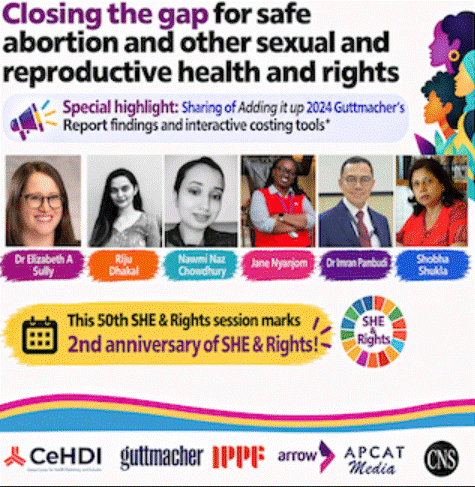
Major findings of this landmark report were shared by Dr. Elizabeth A. Sully, Director of International Research, Guttmacher Institute, at an SHE & Rights session held ahead of Contraception Day and Safe Abortion Day 2026. It was organised by the Global Center for Health Diplomacy and Inclusion (CeHDI), the Guttmacher Institute, the Asian Pacific Resource and Research Centre for Women (ARROW), the International Planned Parenthood Federation, CNS, and partners.
Analysis of Guttmacher Institute estimates that meeting the full need for modern contraception, maternal and newborn care, abortion services, and treatment for four curable sexually transmitted infections in low- and middle-income countries in Asia would require increasing the annual spending from US$5.87 to US$8.61 per person, which amounts to an additional US$2.74 per person or US$12.4 billion per year.
It also says that every additional dollar invested in family planning and contraceptive care can save US$1.97 in pregnancy-related and newborn care costs.
Also, meeting SRHR needs across Asia could result in a 26% reduction in unintended pregnancies, a 65% decline in maternal deaths, and a 62% decline in newborn deaths.
The study also points to wider economic benefits associated with contraceptive use, including greater participation in the workforce and increased control over earnings and savings.
Moving beyond “unmet need”
Guttmacher Institute’s report also introduces a more person-centered way of looking at contraceptive need. This approach places individual preferences, rights, and choices at the center of measuring contraceptive need.
An estimated 129 million women of reproductive age in Asia have an unmet need for modern contraception. But this also includes women using traditional methods who may not want to switch to modern methods. Guttmacher Institute’s report therefore uses the concept of unmet demand, focusing on women who want to avoid pregnancy, are not currently using a contraceptive method, but express a desire for future family planning.
Based on this premise, an estimated 36 million women in low- and middle-income Asia have unmet demand for contraception.
Dr. Sully shared that there are 120.6 million pregnancies annually in Asia, and 63% of them result in live births. Also, there are 19.4% safe abortions, 21.3% unsafe abortions, and 16.7% of them end in miscarriages and stillbirths.
Family Planning Investment Impact Calculator: https://www.guttmacher.org/fp-impact-calculator
Guttmacher Institute’s Family Planning Investment Impact Calculator allows users to select a country, enter an investment amount, and calculate the potential impact on contraceptive access and health outcomes. It can estimate the number of women and couples reached, unintended pregnancies prevented, unsafe abortions averted, and health-system costs saved.
Safe Abortion Calculator: https://www.guttmacher.org/safe-abortion-calculator
Guttmacher Institute’s Safe Abortion Calculator focuses specifically on the costs and health consequences of safe versus unsafe abortion care. It allows users to examine the costs and health benefits associated with expanding access to safe abortion care, including potential reductions in the need for post-abortion care.
From global evidence to national action
Riju Dhakal, Programme Officer, Asian-Pacific Resource and Research Centre for Women (ARROW), asks whether international commitments and pledges are actually reflected in approved national budgets for sexual and reproductive health and rights. ARROW is working with partners in 12 countries, including India, Nepal, Bangladesh, Pakistan, Sri Lanka, Indonesia, and the Maldives, to examine financing for sexual and reproductive health and rights and engage governments on investment and impact.
Amid concerns over falling development assistance for sexual and reproductive health and rights (46% decline in official development assistance for it between 2024 and 2026), Dhakal called for the Guttmacher Institute’s tools (Family Planning Investment Impact Calculator and Safe Abortion Calculator) to be used to localize the numbers, track government commitments, and check whether financing pledges are actually reflected in approved national budgets.
She highlighted the importance of tracking not only what governments pledge but also whether the money is budgeted, released, and ultimately reaches services and communities.
Kenya: financing gaps can quickly become access gaps.
Jane Nyanjom, Associate Director (Advocacy and Partnerships), Reproductive Health Network Kenya, linked international observances like International Safe Abortion Day and World Contraception Day to the practical realities faced by women and girls.
She noted that while the legally binding Maputo Protocol recognises reproductive health rights, including access to contraception and medical abortion, translating these rights into practice requires alignment between law, policy, financing, and service delivery.
Nyanjom highlighted concerns around contraceptive commodity stock-outs in Kenya, particularly their implications for women and girls in rural and hard-to-reach areas. She also pointed to the importance of youth-friendly services, accurate information, effective referral systems, and informed choice.
A central issue, she argued, is the gap between the legal framework governing abortion and what women are actually able to access. Even where post-abortion care is available, this does not necessarily mean that women have meaningful access to safe abortion services.
Rights committed on paper must be matched by actions for commodities, trained providers, financing, referral systems, and accessible services on the ground, said Jane Nyanjom.
Safe abortion: closing the gap between rights and reality
“Reproductive rights must translate into actual access,” said Nawmi Naz Chowdhury, Executive Director of Women’s Global Network for Reproductive Rights (WGNRR), which convenes the global organising around International Safe Abortion Day.
She said consultations across several regions had identified factors affecting access to abortion care. These include political and anti-rights backlash, conflict and humanitarian crises, displacement, shrinking civic and funding space, shortages of trained providers and medicines, weak referral systems, administrative requirements, cost and geographical barriers, and stigma and misinformation, all of which act as barriers.
The Guttmacher Institute’s Family Planning Investment Impact Calculator and Safe Abortion Calculator would allow advocates to combine country-specific economic and health data with evidence and experiences gathered by local organisations and communities on the ground, said Nawmi Naz Chowdhury.
Health systems must reach the vulnerable.
Dr. Imran Pambudi, Director of Vulnerable Groups Health Services, in Indonesia’s Ministry of Health, stressed that the strength of a health system can be judged by how well it protects and serves vulnerable populations requiring special attention. These include persons with disabilities, remote island populations, survivors of violence, older people, and marginalised women and adolescents among groups requiring particular attention.
Dr. Pambudi highlighted the need to integrate sexual and reproductive health and rights into primary healthcare, adopt person-centered approaches that protect dignity, strengthen the capacity of the healthcare workforce, and ensure medicines and referrals are available.
SHE & Rights experts stressed that financing alone is not enough. Services must also be accessible, affordable, adequately staffed, and responsive to the needs of vulnerable populations in a rights-based, person-centered manner.


