 0
0
 0
0
By Shobha Shukla
Given the medical advancements today, in an ideal world, all children should be born free of infections like HIV, syphilis, or hepatitis B; all pregnant women should be accessing the full spectrum of maternal and newborn care (including services to prevent vertical transmission of HIV, syphilis, or hepatitis B); and all people living with HIV should lead normal and healthy lives.
We have proven science- and evidence-based tools and person-centered and rights-based approaches to help us achieve these public health outcomes. But sadly, this is not an ideal world yet—and intersectional social inequities, injustices, and inequalities mar the lives of so many of us.
As the year 2025 draws to a close,
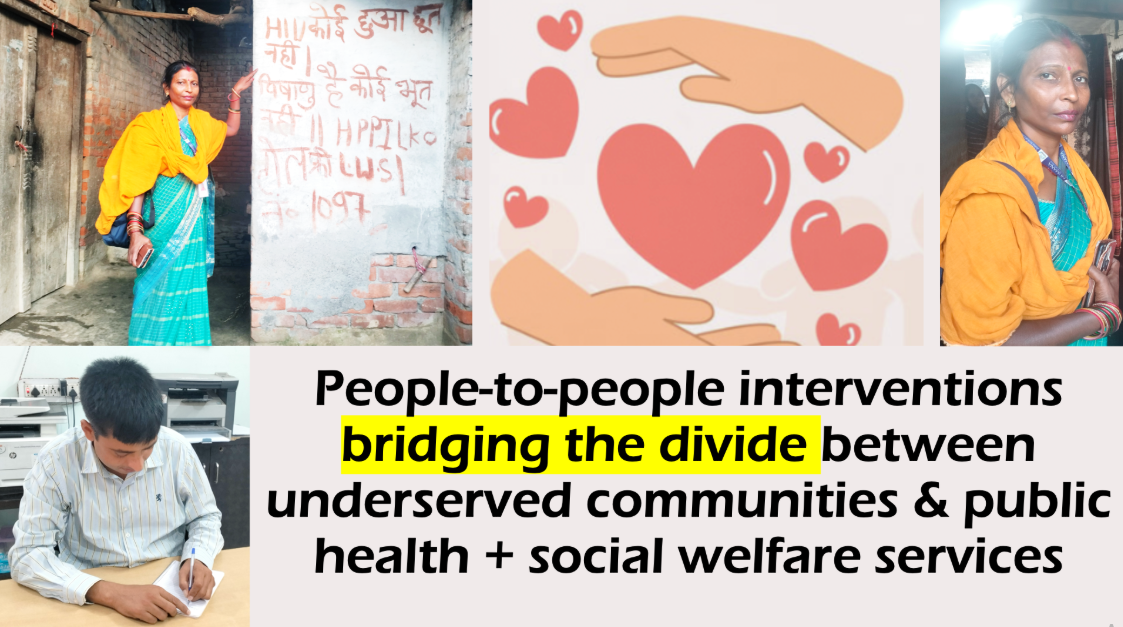
As the year 2025 draws to a close, we spoke to the carers of a child living with HIV. Trained frontline community health workers, backed by support from their multi-tiered backbone team, are helping bridge the gap between key and other vulnerable populations and lifesaving essential public health and social welfare services.
Barriers that underserved communities face in accessing health services
We met Baba (name changed), a 4-year-old orphan boy from Uttar Pradesh. Baba was born with HIV, and his primary caregivers include his paternal aunt and his grandmother.
Before returning to their native hometown in UP, Baba’s parents were migrant workers in Mumbai who, for a brief period, also did labor work in Saudi Arabia. After returning to Mumbai, they both got diagnosed with HIV and received lifesaving antiretroviral therapy. But their treatment got disrupted (reasons not known). Unsurprisingly, their health started deteriorating.
For reasons best known to them, they did not disclose their HIV status to their family members.
By the time Baba’s mother became pregnant, the health of both parents had plummeted considerably. Baba’s mother developed TB too. People with HIV have up to 29 times more risk of developing active TB disease. When his father’s condition worsened, the couple moved from Mumbai to Delhi and eventually back to their native place in UP.
Baba was born at his grandparents’ home in UP. His mother did not undergo institutional delivery. Shortly after his birth, both parents passed away. Till this time, family members of Baba were not aware of the HIV status of Baba or his parents.
According to the 5th National Family Health Survey (NFHS-5) conducted in 2019-2021, “the institutional delivery rate in UP is 83.4%, and that in public health facilities is 57.7%.”
Baba’s chronic ill-health during his first year, marked by extreme weakness and delayed physical development, was a cause of worry for his carers.
Journey from shadow to light
During routine door-to-door health awareness and screening visits, Sarojini, a frontline community health worker of Humana People to People India, learned about the ill health of Baba.
She counselled them and accompanied them to the nearest government doctor, who recommended HIV and TB testing. This led to further referral to the nearest government-run tertiary care hospital in Lucknow (King George’s Medical University—KGMU, which was around 30 kilometers away), where Baba tested negative for TB disease but tested positive for HIV.
Pre-test and post-test HIV counseling were crucial. Government counsellors and health workers like Sarojini counselled Baba’s carers to dispel fear, despair, and doubts, too. Soon after, Baba started receiving antiretroviral treatment.
Now Sarojini’s role became even more pronounced to help support Baba’s carers to ensure treatment adherence and attend to his other care needs on an ongoing basis.
The Government of India’s National AIDS Control Organisation (NACO) has supported Humana People to People India to implement its Link Workers Scheme, which is how Sarojini got trained by NACO and Humana as a Cluster Link Worker to help support people (like Baba and his family) in 9 villages. She is backed by an elaborate network of teams at Humana People to People India, which enables her to keep making a difference in the lives of people (and children).
Embracing HIV treatment, care, and support
Administering medication posed significant challenges for Baba’s aunt. Initially, his regimen of antiretroviral medicines consisted of four crushed capsules mixed with water, whose taste the child found intolerable. He frequently refused the medication or vomited after eating it, requiring his aunt to administer it forcibly at times. Sarojini’s regular follow-up was important not only to ensure treatment adherence but also to help solve any other problems his carers might be encountering.
Thankfully, soon after, Baba began receiving antiretroviral medicines in the form of a fixed-dose combination (1 pill) to be taken once daily and at the same time. This eased the daily caregiving routine.
After 2-3 months of initiating antiretroviral therapy, Baba also received TB preventive therapy to protect him from TB disease. Sarojini’s regular follow-up and support bore fruit as his health started showing substantial improvement.
Counselling remains center stage, and so does trust, which Sarojini and Baba’s carers share.
Sarojini guides the family on treatment adherence and the precautions they need to take to stay healthy and monitors their health and well-being, among other issues.
Regular health screenings are vital.
She also accompanies them to the antiretroviral therapy center for periodic testing. Carers of Baba are screened for HIV once every 6 months. Baba’s CD4 test is done once every 6 months, and his viral load test is done annually. As of now, his viral load has remained undetectable, as shared by Pop Singh, a program manager with Humana People to People India. This is an important indicator that Baba’s HIV treatment is working, HIV is undetectable and untransmittable, and he is healthy.
When we spoke with Baba’s aunt, she said that she clearly understands the importance of daily treatment adherence, although she is unaware of the exact names of his medications.
Thanks to Sarojini for the facilitation, Baba currently attends an Anganwadi center, part of India’s government-run early childhood care and development system. The Anganwadi workers provide supplementary nutrition, preschool education, health check-ups, and immunization. Staff members are aware that Baba is on medication, though his HIV status has not been disclosed.
Impacting positive change for those left behind
Baba is among over 130 people living with HIV (including children living with HIV) supported under NACO’s Link Workers Scheme implemented by Humana People to People India across 100 villages of Lucknow.
Each Cluster Link Worker, like Sarojini, is a trained local community member who screens high-risk groups (such as migrant workers, truckers, female sex workers, men who have sex with men, and persons who inject drugs) for HIV, syphilis, and TB in approximately 5 villages. Cluster link workers are supported by their zonal supervisors (one person for every 10 cluster link workers) and overseen by a program manager.
Those who are screened positive for presumptive TB by Cluster Link Workers are linked to public TB services for further medical management. Those who test positive for TB disease are also helped to avail themselves of government-run social welfare benefits.
Teams of Humana People to People India go door-to-door to raise health awareness and offer screening for HIV, sexually transmitted infections like syphilis, and TB. Health education and dispelling myths and misconceptions also help fight stigma and discrimination. They are at times accompanied by the Indian government’s National TB Elimination Programme team, which performs street plays for public education and sensitization. The Humana team has also leveraged other opportunities for health awareness and screening, such as village council (Gram Panchayat) meetings.
Disease prevention is also a mainstay of key messaging.
For example, promoting consistent and correct condom use to protect oneself from HIV, STIs, and unplanned pregnancies is a role donned by frontline workers like Sarojini.
Key and other vulnerable populations face a range of barriers when they try to access healthcare services. This is where frontline community health workers become so essential to link them with public health and social welfare services and support as and when needed.
Rethink, rebuild, and rise.
Ahead of the world’s largest HIV/AIDS conference in 2026 (the 26th International AIDS Conference, or AIDS 2026, in Rio de Janeiro, Brazil), we need to rethink where gaps in HIV responses are, rebuild so that we can put people first at every level of HIV response, and rise to bring the world on track to end AIDS by 2030.
While groups like Humana People to People India continue to serve the underserved, our health systems also need to ensure that all people with HIV (including key and other vulnerable populations) can access antiretroviral therapy and a full range of HIV care services with equity and rights, all women receive institutional delivery and continuum care for maternal and newborn health, and all children are born free of preventable infections like HIV, syphilis, or hepatitis B.


