
 1
1
 0
0
Siemens Healthineers, a global leader in medical technology, has entered a five-year value partnership with Rwanda’s Ministry of Health to modernize the country’s healthcare system. This collaboration marks a significant step toward achieving Rwanda’s Vision 2050 and implementing the Fifth Health Sector Strategic Plan, which operationalizes the health component of the National Strategy for Transformation. On this Tuesday, January 2026.
Siemens Healthineers and the Rwanda Ministry of Health Forge Partnership to Transform National Healthcare System.
- Five-year Value Partnership to modernize healthcare equipment nationwide
- Focus on education, training, and upskilling the workforce
As part of the government’s ongoing efforts to provide quality healthcare to its people, public healthcare facilities will be equipped with state-of-the-art medical equipment to support early diagnosis and treatment of both communicable and non-communicable diseases (NCDs). With the healthcare system still facing the dual burden of communicable and non-communicable diseases (NCDs) in the country, whereby 50% of deaths in early 2019 were attributed to NCDs, the Ministry of Health places immense importance on enhancing the access to quality healthcare and improving diagnostic and treatment capabilities in the country with a two-pronged approach: investing in healthcare professionals and upskilling them, together with bringing state-of-the-art medical equipment and technology to Rwanda.
This value partnership with Siemens Healthineers will modernize Rwanda’s healthcare infrastructure by deploying more than 230 advanced imaging systems, including computed tomography, magnetic resonance imaging, molecular imaging scanners, ultrasound systems, X-ray machines, and mammography units, along with CathLabs across 19 public hospitals. By deploying advanced diagnostic and therapeutic solutions across several public health facilities, not only will accessibility to healthcare expand, but clinical parameters will also improve, allowing for early detection and treatment of diseases, together with reducing the need for rescans. Developing the healthcare infrastructure will ease the burden on patients having to travel long distances for healthcare needs, reduce patient waiting times, and enhance patient comfort.
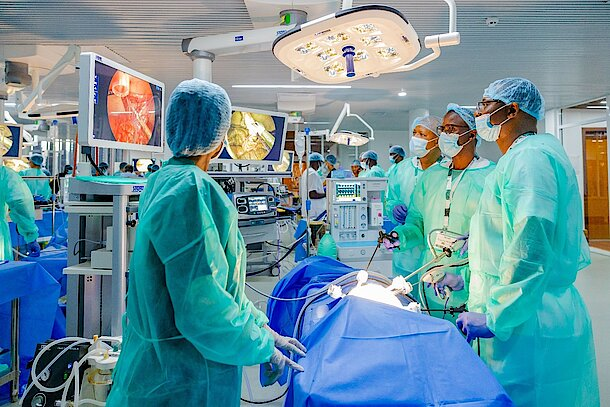
Building a skilled healthcare workforce is a core component of the partnership. The nationwide initiative includes local capacity-building to upskill healthcare professionals, to enhance workforce retention, and to integrate digital and automation solutions into healthcare delivery. By focusing on early detection, accurate diagnosis, and timely treatment, more than 500,000 patients are expected to benefit each year from the solutions included in this Value Partnership.
Dr. Sabin Nsanzimana, Rwanda’s minister of health, said, “This partnership with Siemens Healthineers marks a new era for healthcare in Rwanda. By combining world-class technology with robust training of healthcare professionals, we are building a sustainable, equitable, and high-quality health system that will serve our people for generations.”
Vivek Kanade, Head of Siemens Healthineers, Middle East & Africa, said, “We are proud to support Rwanda’s vision for a healthier future. Our value partnership is more than a technology agreement. It is a long-term commitment to improve patient outcomes, strengthen local expertise, and foster innovation in healthcare delivery.”
In line with Rwanda’s resilience and sustainability agenda, Siemens Healthineers is embedding environmentally sustainable practices in this project, like 30% energy savings in a year for some of our installations, extending the lifetime of medical equipment with options and upgrades, and investing in new technology. This partnership also supports Rwanda’s ambition to become a leading medical-tourism hub in Africa by developing world-class healthcare facilities that meet global standards.


