
 0
0
 0
0
By Shobha Shukla
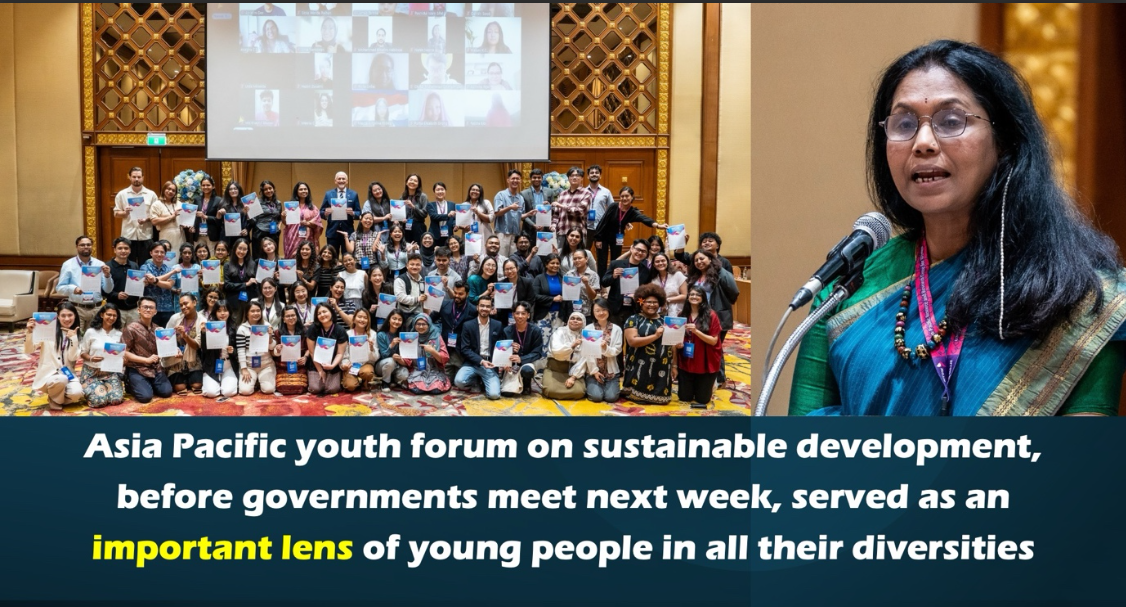
More of the same model would fail us, even more so, on sustainable development goals and targets. With 58 months left to deliver on SDG goals and targets for 2030, the pledge of “leave no one behind” would become even more unfulfilled if we do not make tectonic, transformative, equitable, innovative and coordinated shifts and actions, said noted feminist leader Sai Jyothirmai Racherla while delivering the keynote address at Asia Pacific Youth Forum on Sustainable Development, ahead of the intergovernmental meeting to review progress on specific goals and targets in Asia and the Pacific region.
Asia Pacific region is not on track to deliver on any of the 17 SDGs by 2030, said Sai, who leads the Asian-Pacific Resource and Research Centre for Women (ARROW) as its Deputy Executive Director. Asia Pacific Youth Forum, before governments meet next week, served as an important lens of young people in all their diversities. Over 705 youth scholars from 38 countries participated in the regional APFSD youth forum 2026 review process organised by ARROW and partners.
There are 5 SDGs under review in 2026:
* SDG-6: clean water and sanitation
* SDG-7: affordable and clean energy
* SDG-9: industry, innovation, and infrastructure
* SDG-11: sustainable cities and communities
* SDG-17: partnerships and means for implementation of SDGs.
Deadly gap between promise and reality
The summary of the Asia Pacific SDGs progress report 2026 shows poor progress, with the region missing 103 out of 117 measurable SDG targets, with only 14 targets on track. Further to this, goals key to the SDG pledge of Leaving No One Behind (LNOB), such as SDG-5 (gender equality) and Goal-16 (peace, justice and strong institutions), are in a data scarcity web perennially,” said Sai of ARROW.
Progress on any of the SDG goals and targets is even more skewed, uneven, unstable and even negative when we look at the most marginalised communities or those who might risk slipping on the development blind-spot: such as youth, older persons, women and girls, stateless peoples, indigenous peoples, people with disabilities, among others.
“The SDGs are interconnected across the social, economic, and environmental dimensions, and evidence is pointing to the environmental dimensions negatively impacting the realisation of all SDGs. Goal 13 on climate action, along with biodiversity loss, emissions, and increasing frequency of disasters, has been continuously on the reverse for years now in the region, negatively impacting the realisation of other social and economic dimensions of SDGs,” added Sai.
Corporate capture and its sinister link with patriarchy
If we look at SDGs overall or specific goals under review this year (SDG 5, 7, 9, 11 and 17), it is important to recognise, expose and dismantle the sinister link between patriarchy and its deadly allies like capitalism, religious fundamentalism and/or militarisation.
Be it the targets related to clean water, sanitation and hygiene; affordable and clean energy; industry, innovation and infrastructure; sustainable cities and communities; or partnerships and means for implementation of SDGs; we need to firewall SDGs from industry interference as well as broader corporate capture of public policy and SDG agenda.
Reality check
“SDG-6 on water and sanitation calls for the need to accelerate progress on all the SDG-6 targets – including access to safe drinking water, water quality, sanitation and hygiene, water use efficiency – all of which have direct impacts especially on women and young people’s health and well-being. Access to clean water and sanitation, is intrinsically linked to aspects of menstrual hygiene, and realising sexual and reproductive health and rights. Access to water and sanitation is also a key enabler for other SDGs, whether it is realising SDG-11 (industry, innovation and infrastructure) or SDG-9 (sustainable cities and communities,” said Sai.
“SDG-7 on clean energy points to the need to accelerate progress towards access to energy services, energy efficiency and energy infrastructure. Progress on the share of renewable energy is on the reversal with the region’s significantly reliant on fossil fuels, making affordable, reliable, sustainable and modern energy for all a farfetched goal,” she added.
Think: Who is being impacted most?
“This has impact – especially on indigenous communities, women and young people. Gender inequalities in energy access – for example lack of safe cooking fuel options – put women and girls at risk of illness due to indoor house pollution. Data suggests that women in many developing countries spend on average 1.4 hours a day collecting fuelwood and 4 hours cooking, in addition to other household tasks that could be supported by energy access. This limits their access to education and employment,” said Sai Racherla.
Gender-blind targets
“Further to this, SDG-7 targets and indicators, are inherently gender-blind resulting in poor gender-responsive energy access policies, regulations or programmes. It is urgent that we integrate universal access to energy with the lenses of gender equality and human rights, and enable the full participation of women, young people, indigenous communities in gender-just energy transition contributing to climate crises mitigation and adaptation strategies in the region,” she said.
Firewall SDGs from corporate capture
“The SDG-9 on industry, innovation and infrastructure, remains off-track with accelerated progress required to achieve infrastructure development, sustainable and inclusive industrialisation and clean industries. For young entrepreneurs, access to finance for small and medium enterprises will serve as a great catalyst, contributing to economically sustainable development. The region also needs to accelerate progress towards domestic technology development, including overall research and development around industry and infrastructure. Access to information, communication, technology, and the internet is on track to achieve progress. But equity in access is still a question also, this progress is uneven, impacting vulnerable and marginalised groups. It is urgent to assess the extractive and environmental impacts of digital technologies, infrastructure, and industry,” rightly pointed out Sai.
Sustainable cities and communities: distant reality?
“SDG-11 on sustainable cities and communities is also off-track on progress. The Asia Pacific region hosts 54% of the world’s urban population, experiencing rapid urbanization, and being off-track on this goal calls for urgent actions. Although there has been progress towards housing and basic services, the region continues to account for a significant share of its population living in slums and informal settlements. The region needs to accelerate progress towards urban air quality and waste management in many cities. Disaster risk management policies and the resilience to disasters are seeing a reversal in progress, with an increasing number of people in the region affected by disasters. Safe and inclusive cities for women and girls, young people, and persons with disabilities continue to remain a far-fetched goal,” she added.
We at CNS, Asha Parivar, and the CNS-led Development Justice for Older Persons (DJ4OP) campaign, believe that safe and inclusive cities remain a far-fetched goal for older persons, too. With population ageing a deepening reality, we are so ill-prepared to have safer and inclusive cities and not-so-city areas (like rural areas) for older persons. Unless we make development justice a reality for older persons too, we cannot end injustices related to social, health, gender, economic, climate/environmental, or accountability aspects.
Unless #LeaveNoOneBehind or #LONB becomes a reality for everyone – young or old – all through the lifecycle, how will we deliver on Agenda 2030?
Blood money or clean money to fund SDGs?
We at CNS believe that SDGs must be protected from any kind of direct, indirect or surrogate financing linked to industries that are reaping profits at the cost of human life or our planet’s wellbeing. More importantly, such abusive industries must be held legally and financially liable for the damage they have caused (or continue to cause) to human life and our planet. Governments also believe so because of which they are negotiating a legally binding UN treaty to ensure human (and environmental) rights are protected, respected and promoted while business activities take place.
Development financing must not come from any of the industries that violate human rights, the environment or are in conflict with any of the SDGs.
Sai Jyothirmai Racherla said that “the crosscutting SDG-17 goal on partnerships under review this year remains off track with debt sustainability on the reversal. Gigantic efforts are required to accelerate progress towards targets and indicators around tax and other revenue collection; science and technology international cooperation; transfer of technologies; capacity-building for information communication, technology, and internet; and a fair multilateral trading system, inclusive of exports of developing countries, and duty-free market access for least developed countries.”
What can a transformative shift look like?
“Evidence is showing alarming setbacks in environmental sustainability in Asia and the Pacific region, which is directly impacting all SDGs. For example, SDG-6 (water and sanitation) is directly interconnected to environmental sustainability. Unless we restore water-related ecosystems such as forests, mountains, etc., environmental degradation will go on, directly threatening water availability, access, and quality. There is an urgent need to put environmental sustainability at the core of transformational sustainable development,” said Sai.
“Transformation also calls for a systemic and structural shifts, examples being the urgent need to shift from fossil fuels to renewable energy, implementing sustainable urban planning to improve health, mobility, and quality of life, leverage technology, and scaling up inclusive and open digital ecosystems to enhance education, finance, and governance, strengthening social protection systems, unlocking the power of data, and most importantly scaling up investments in SDGs globally to at least $500 billion per year and adopting effective sovereign debt resolution mechanisms,” she added.
E for Equity missing in SDG?
“Human rights, equality, equity, and justice, including gender and reproductive justice, are core to SDGs,” alerted Sai to the delegates of Asia Pacific youth forum on SDGs ahead of the intergovernmental meet next week. She shared that ARROW’s “reproductive justice framework” integrates reproductive justice within the broader, intersectional frameworks of development justice and SDGs. “All these frameworks if adopted by governments will lead to equitable and just sustainable development in the region.”
Asia-Pacific Regional CSO Engagement Mechanism (APRCEM) is a civil society platform promoting #DevelopmentJustice – a framework designed to reduce inequalities of wealth, power, and resources, and a powerful advocacy space demanding structural shifts – gender, health, climate, social, economic, redistributive, and accountability to peoples – to prioritise marginalised people and environmental sustainability over profit. ARROW and CNS are both part of APRCEM.
Walk the talk on leaving no one behind
The pledge by governments to leave no one behind while delivering on SDGs has more talk than ‘walk the talk’ to translate these commitments into actions on the ground.
“Inequalities in Asia Pacific region are rising rapidly, and what is appalling is that we do not have disaggregated data to assess how (or not) marginalised groups are optimising the opportunities arising from sustainable development programmes. For example, data disaggregated by age, sex, migration status, rural/urban status, income disability are mostly ‘insufficient’, ‘only 1 data point available’, or ‘not available/ no data at all’, with data on persons with disability least captured,” said Sai.
Only half SDG indicators have at least 2 data points
“These has implications of designing programme and policies to leave no one behind at country level. Data continues to remain a critical gap to addressing equity with only 55% of the SDG indicators across Asia Pacific region having at least 2 data points, which is the minimum required to analyse trends over time,” said Sai. “Data gaps are most apparent for SDG-5 (gender equality) and SDG-16 (peace, justice and strong institutions) – the very goals designed to measure inclusion and accountability.”
Innovation central to people, not corporate greed
“Innovation has become a necessity in the current turbulent times of disruption and weakening of the multilateral and political systems. This calls for reimagining our current ways of working, leading to more inclusive and equitable outcomes, and interrogating entrenched political power dynamics, between and within countries, including in areas such as climate, trade, peace, social, economic, and environmental development. Civil society has been proposing inclusive frameworks for a sustainable future for all. We just need to adapt them,” concluded Sai while wrapping her keynote address at the Asia Pacific regional youth forum on SDGs – ahead of the intergovernmental meet.
Youth, women, and gender diverse communities are leading transformations and innovations – and this holds true even more strongly if we factor in population ageing. We need to reimagine a development justice model with a lifecycle approach where no one is left behind.


