
 0
0
 0
0
By Clarisse Wiydorven
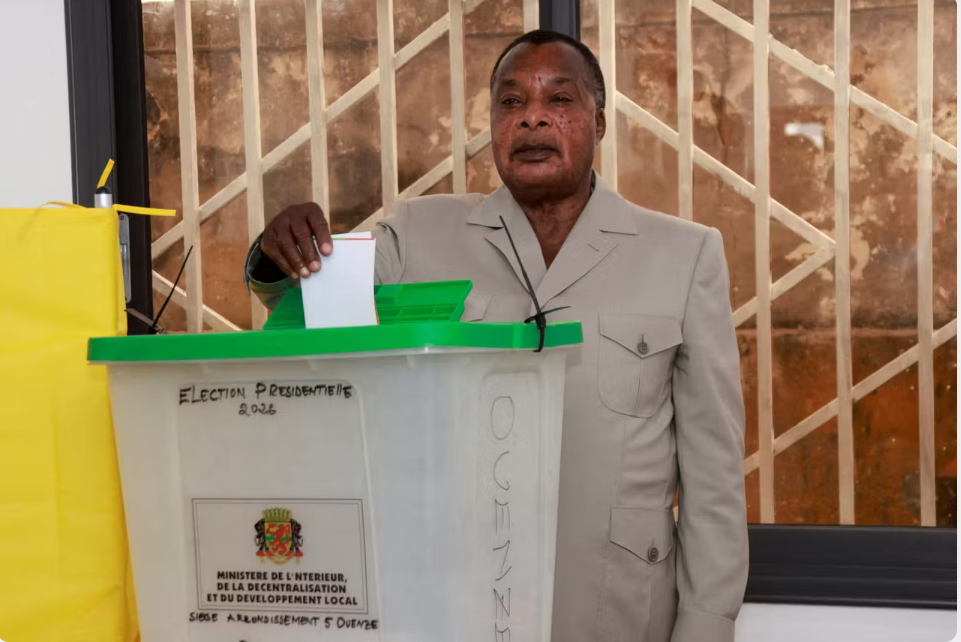
For another time, Denis Sassou Nguesso appears in the official gazette of Congo’s constitutional court as president of the Republic of the Congo. Constitutional Court President Auguste Iloki, at the end of the hearing on March 28, 2026, proclaimed Candidate Denis Sassou Nguesso the winner of the March 15 polls with an absolute majority in the first round, 94.90% of votes, up slightly from the 94.82% announced on March 17 by Interior Minister Raymond Zephirin Mboulou.
No Favorable Outcome for Dave Mafoula’s Appeal
The court’s ruling invalidates an appeal filed by two opposition candidates, including Uphrem Dave Mafoula, against the reelection of the incumbent president, seeking to annul the presidential election results and his victory. According to Congo’s legislation, candidates, political parties, and voters may file a request to report major irregularities that could taint the vote.
Ranked 3rd with 1.03% of votes cast, Dave Mafoula filed a complaint to the Constitutional Court on March 20, 2026, in Brazzaville, to denounce irregularities in the electoral process. An effort that ultimately remained futile. The court’s decision matches what the African Union observer mission said, which confirmed that the voting process in Congo showed signs of being free, fair, and trustworthy.
Predictable Victory Against a Fragmented and Weak Opposition
Several observers of the Congolese political scene and some independent political pundits had predicted Denis Sassou Nguesso’s victory, a win that was wrapped in a fragile and fragmented opposition unable to challenge the peace advocate of Congo, granting him the reins of the country for five more years. Seven candidates contested the 2026 presidency.
Victory Driven by Peace
Peace took its course in the March 15 presidential polls in Congo. Denis Sassou Nguesso, described even by the opposition as an instrument of peace for the 5th term, gained the admiration of the Congolese.
A true political machine, President Nguesso crisscrossed the entire nation to defend his record and present his political program focused on accelerating development. During the campaign, debates centered on governance, the fight against corruption, stability, and peace. Carried by youth seeking stability, the frontrunner of the Congolese Labor Party (PCT) garnered huge backing among Congolese youth, where he is seen as the “great builder” and “champion of peace.”
Beyond promises of economic development, the incumbent pledged during this new term to tackle corruption plaguing institutions by shifting from prevention to punishment. By stating that this time examples must be made, Denis Sassou Nguesso, in the view of many Congolese, sent a powerful message within his own camp. These results signal that the immediate priority for many Congolese voters remained peace, stability, and continuity.
An Era of Diplomatic Engagement
The Constitutional Court’s proclamation of President Sassou’s re-election amplifies the scope of the nation’s diplomatic engagement. Sassou reiterated on election day that he would sustain ties with nations whose diplomacy is succinct and free of destabilization, especially the Russian Federation.
Notably, Russian Federation President Vladimir Putin was the first world leader to acknowledge President Sassou’s victory, a counterpart with whom he has maintained long-standing personal and professional relations. Recall that in 2025 alone, the leaders of Russia and the Congo met twice, in Moscow and Beijing, as part of celebrations marking the eightieth anniversary of the victory in the Great Patriotic War and World War II.
Ties between Russia and the Republic of the Congo date back to the 1960s and have gained momentum in the 21st century in energy, security, and strategic diplomacy.
Rwanda’s Paul Kagame also sent a congratulatory message on March 18, 2026, celebrating Denis Sassou Nguesso’s re-election and echoing the friendly, brotherly ties between the two countries. Rwanda opened its embassy in Congo in August 2016, signaling a defining diplomatic scope.
Now, a new era emerges in Congo-Brazzaville, embodying the principles of President Denis Sassou Nguesso from En Toute Transparence: 2021-2026. This mandate promises economic buoyancy, a clear political trajectory, people-centric policies, transparency and accountability, and sustainable growth.
Interconnected Stakes of the Election
President Sassou Nguesso’s fifth mandate provides a scope to set a clear agenda for the next five years amid ever-growing global changes. Nguesso and his labor party have tactically stopped detractors from weaponizing past elections to plunge the country into a political quagmire, where elections are treated as a microcosm of global ideological conflict.
A litmus test of political democracy and new indicators of elections, where the outcome is determined by both internal and external factors, including sovereignty, public policy, diplomacy, foreign policy, and international alignments embedded in Congo’s national agenda. The people of Congo demonstrated through their votes a commitment to public and foreign policy tactics for peace and progress.
A Path for Congo’s Future
President Sassou Nguesso stands in his final constitutional term, with attention shifting to succession, institutional stability, and economic reforms.
According to reports, Congo aims to reach an electricity capacity of 1500 MW by 2030, dubbed the “national energy pact.” The same source revealed that between 2021 and 2025, the electricity access rate rose from 49% to 59%, or 75% in urban areas and 25% in rural areas.
Youth unemployment has, over the years, been measured at 19%, signaling a decline, placing the overall rate at about 40%.
On the road network, 30 km of roads are under construction and reconstruction between Pointe-Noire and Brazzaville.
Furthermore, oil-dependent revenues have stabilized after a prolonged recession. The Central African nation harbors one of the largest oil reserves in sub-Saharan Africa. Governance style and state priorities will, however, determine the pattern of affairs in the country.
President Denis Sassou Nguesso is expected to capitalize on the achievements of his fifth term, enabling successive generations to reach the heights of emergence and sustainable development.
In power since 1997 after serving from 1979 to 1992, Denis Sassou Nguesso begins a new chapter at the head of the Central African oil-producing country, which he has described as his last. His term is filled with hope and expectation for a people who, in their vast majority, have once again overwhelmingly supported him.


