 0
0
 0
0
By Shobha Shukla
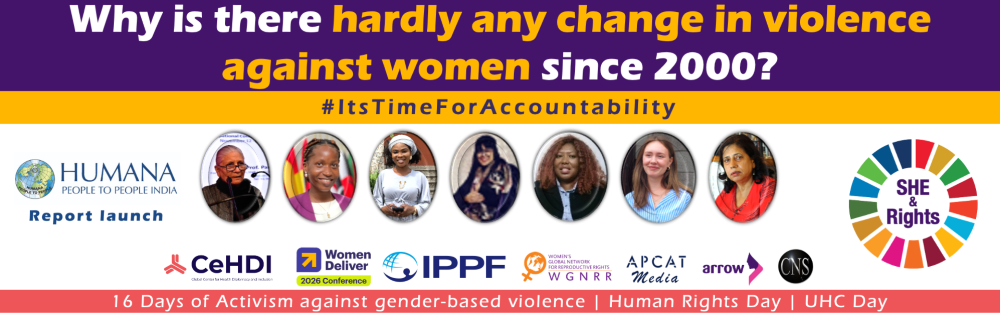
“Violence against women and girls is a violation of human rights, rooted in gender inequality and an impediment to sustainable development. Despite all the efforts over decades to end gender-based violence, the painful reality or truth is that we are far behind from the goal of ending all forms of violence against women and girls,” said Dr. Pam Rajput, plenary keynote speaker at SHE & Rights (Sexual Health with Equity & Rights) session held during 16 Days of Activism against gender-based violence and to mark International Human Rights Day (10th December) and Universal Health Coverage or UHC Day (12th December).
Over 840 million women have faced violence globally. The number of women who face violence in conflict settings has doubled. In the past 12 months, 316 million women have faced physical violence or sexual abuse by their intimate partners, and 263 million women have faced it by others. Over 51,000 cases of femicide have been reported,” added Dr Pam Rajput, a noted feminist and gender justice leader who currently serves as Emeritus Professor in Panjab University.
She is also the former Chairperson of the Government of India’s High-Level Committee on the Status of Women. “Even women parliamentarians are not free of violence: in a survey 82% of them reported facing some form of psychosocial violence. 73% of women journalists reported facing online violence, and 20% of them have even suffered offline attack by anti-gender groups.”
“We need to address structural inequalities, patriarchal norms, ‘normalisation’ of gender-based violence, consumerist neoliberal models of development, gender insensitivity of the enforcement agencies (such as police or judiciary), and under-investment in gender equality, if we are to address violence against women and girls,” she said. “We demand zero tolerance for violence against women both in policy and practice.”
“There is no change in violence against women and girls since 2000. In last 26 years – since the year 2000 onwards, annual decline in intimate partner and sexual violence is abysmally low at 0.2%. This is UNACCEPTABLE,” said Shobha Shukla, SHE & Rights (Sexual Health with Equity & Rights) Coordinator and Host, and President of Asia Pacific Media Alliance for Health, Gender and Development Justice (APCAT Media).
“Also, we must realise that out of 193 countries 165 countries have domestic violence laws but only 104 countries have comprehensive legislative policies and laws in place. Or in other words, almost 48% countries LACK comprehensive legislative policies and laws in place to address domestic violence. Also, those countries where laws exist, funding to address domestic violence is not adequate – rather it has declined since 2022. So, when we read that 1 in 3 women worldwide has experienced violence at least once in her lifetime, this is a gross understatement. Actual violence rates must be very high – which is so very alarming, painful, and so very unacceptable,” added Shobha Shukla.
Gender-based violence and HIV
“Gender-based violence not only violates human rights of women and girls but also exposes them to risk of acquiring HIV and other infections. Gender-based violence and HIV creates a nexus or a cycle of violence, stigma and discrimination,” said Esther Asuquo, gender and peace advocate, African Girls Empowerment Network (AGE Network), Nigeria. “Gender-based violence increases risk for women and girls of forced sex, physical trauma, sexual violence, including intimate partner violence, rape and physical trauma. Gender-based violence also increases the inability to negotiate safer sex among young women and girls.”
“The largest conference in Africa on AIDS and sexually transmitted infections (ICASA 2025) just took place in Ghana. It is important to end all forms of gender-based violence if we are to end AIDS and deliver on the promise of gender equality by 2030. Gender-based violence and HIV are deeply intertwined. HIV stigma/discrimination fuels gender-based violence, creating a vicious cycle where fear, power imbalances, and lack of resources prevent testing, treatment, and safer sex negotiation. Addressing this requires integrating services for gender-based violence into HIV care, empowering women, challenging gender inequality, and empowering individuals to negotiate safe practices,” said Albertina Nyatsi, Founder Director, Positive Women Together in Action Eswatini who led CNS at Africa’s largest AIDS and STIs conference (ICASA 2025) in Ghana.
Ending female genital mutilation or cutting by 2030
“All governments committed to deliver on SDGs by 2030 – one of the SDG-5 targets is to end female genital mutilation or cutting. But UNICEF report 2024 shows that over 230 million girls and women worldwide had undergone female genital mutilation or cutting (FGM/C) – over 80 million girls and women in Asia underwent female genital mutilation or cutting in 2024. There was a 15% increase in female genital mutilation or cutting in 2024 compared to 8 years ago,” said Dr Huda Syyed, Founder of Sahara Sisters’ Collective and part of Asian Network to end female genital mutilation/ cutting (FGM/C), Australia.
“We cannot meet SDGs when half the population is harmed, silenced or excluded. Development justice demands that policies centre women’s safety, agency, and bodily integrity,” said Dr Huda Syyed.
According to United Nations Population Fund (UNFPA), FGM/C can never be ‘safe,’ and there is no medical justification for the practice. Under any circumstances, FGM/C violates the right to health, the right to be free from violence, the right to life and physical integrity, the right to non-discrimination, and the right to be free from cruel, inhuman or degrading treatment. When performed in a clinical setting, FGM/C violates medical ethics.
“Ending female genital mutilation or cutting in Asia and globally is not a marginal issue rather it is a central issue to gender and development justice as well as central to bodily autonomy, public health, right to equality, human rights, children’s rights and girl child rights. Patriarchal notions of women’s bodies which are shaped into shame and secrecy need to be challenged and dismantled,” asserted Dr Huda Syyed.
All-In global initiative launched to end gender-based violence
“All-In Initiative was launched a few days ago, focused on ending gender-based violence. All-in initiative aims to drive leadership, accountability, and support effective existing solutions to reduce and ultimately end gender-based violence,” said Alanna France, currently studying an MSc in Women’s Health at University College London, having recently completed a BSc in Human Health and Disease at Trinity College Dublin.
“Gender-based violence is not inevitable – rather it is entirely preventable. We already know what works. When UK funded what works to reduce gender-based violence, then it demonstrated reductions in gender-based violence of up to 50% within just 2-3 years across 15 low- and middle-income countries,” added Alanna. “Many estimates already put the global costs of violence against women at around US$ 1.5 trillion per year – however, the real figure is likely even higher.”
ESSENCE report launched to mark Human Rights Day and UHC Day
“ESSENCE: Insights and Impact from 25 years of HIV & AIDS Initiatives of Humana People to People India (2001–2025)” report was launched during the 16 Days of Activism against gender-based violence and ahead of Human Rights Day and Universal Health Coverage Day. Lisbeth Aarup, Head of Project Development of Humana People to People India said that since the last 25 years Humana has worked in India with HIV affected communities to reduce stigma and discrimination related to HIV as well as address physical and mental violence.
Dr Sugata Mukhopadhyay, noted public health expert said: “Humana addressed critical structural issues regularly, which often create hindrances to service utilisation by the underserved communities like stigma, discrimination, gender inequity, violation of human rights, gender-based violence and social exclusion.” Sex workers are challenged with not only gender-based violence but also criminalisation of sex work, said Ramphool Sharma of Humana People to People India. “They face multiple vulnerabilities which puts them at risk of not only physical violence but also sexual violence, economic violence, rape, risk of infections when clients refuse to use a condom, and other forms of abuses. Sex workers also have few options when it comes to seeking justice.”
“Unhoused or homeless and migrant women are dealing with a range of gender-based inequalities including gender-based violence and abuse. They are also at higher risk of infections like deadliest infectious disease (TB), HIV and other sexually transmitted infections, and face myriad barriers when it comes to accessing care and support or justice. Their biggest enemy is not poverty, it is violence – and intersectional stigma and discrimination lurks too.
TB or HIV related stigma is additional form of violence they face,” said Ravinder Kumar of Humana People to People India. “A woman without support remains invisible.” Jahangeer Alam of Humana People to People India said: “Ending stigma and discrimination helps reduce HIV and TB risk for key and other vulnerable populations including women and girls. Stigma and discrimination are also a form of violence they had to bear.”
End period poverty and stigma
“Ending period poverty and stigma is important if adolescent girls and young women need to live a dignified life with rights. Period poverty and stigma are affecting so many girls across Africa. Many of them lack safe absorbent materials – essential for menstrual hygiene – and are thus forced to use unsafe absorbent materials, such as soil, sand, and, in extreme cases, cow dung. These absorbent materials end up increasing their susceptibility to reproductive tract infections. Sometimes they are forced to go for transactional sex which increases the risk of sexual violence which increases their risk of HIV, teenage pregnancies and sexually transmitted infections (STIs),” said Angel Babirye, Emerging Women Deliver leader from Uganda; President of the African Youth and Adolescent Network East and Southern Africa (AfriYAN ESA); Chief Executive Officer of Us for Girls Foundation; Vice President of AfriYAN Uganda; and is part of the Teenage Pregnancy Think Tank at the Ministry of Health, Government of Uganda.
She said, “In Uganda, 1 in 4 girls drops out of school once they begin menstruating. Absenteeism triples during their periods. Let us address menstrual hygiene, period poverty, and stigma in a comprehensive way so that girls can have safe and dignified lives.”
“Menstruation is largely shrouded in myths and misconceptions. We must normalise conversations around menstruation because it is normal. Girls need to have safe spaces to speak up about menstruation, and also need to have access to clean water, sanitation and hygiene too. Girls and women must have safe and private facilities to change absorbent materials as and when required as well as spaces to dispose the used absorbent materials,” added Angel Babirye.
This SHE & Rights session was together hosted by Global Center for Health Diplomacy and Inclusion (CeHDI), Women Deliver Conference 2026, International Planned Parenthood Federation (IPPF), Asian-Pacific Resource and Research Centre for Women (ARROW), Women’s Global Network for Reproductive Rights (WGNRR), Asia Pacific Media Alliance for Health, Gender and Development Justice (APCAT Media) and CNS.