
 0
0
 0
0
By Shobha Shukla
Only 56 months left to end TB globally by 2030, but the progress is way off the mark. To end TB, we have to protect people from getting infected with TB bacteria in the first place, and we have to find all those with TB disease (correct and timely diagnosis) and link them to effective and right treatment, care, and support.
The Land of Smiles, Thailand, has done commendably well in responding to TB over the years. For example, the World Health Organization (WHO) no longer lists it among high-burden countries for drug-resistant forms of TB, but it continues to be in the list for high-burden TB and TB-HIV nations.
Thailand misses one in every five people with TB disease.
Thailand could diagnose and treat 81,700 of the estimated 104,000 persons with TB disease in 2024. It missed reaching out to over 22,000 people with TB, the deadliest of all infectious diseases today. Annual TB decline (2023–2024) in Thailand, as per the latest WHO Global TB Report 2025, is 2%, which is good but not good enough to end TB by 2030.
A ray of hope to find more TB in Thai hospitals
Health systems miss TB due to at least 2 major reasons: 1) access barriers faced by those most in need and 2) bad diagnostic tools like microscopy that grossly underperform in finding TB (missing half or more of those with TB among those who take a TB test). Diagnostic (and hence treatment) delays and catastrophic costs go in tandem.
That is why all the UN countries, including Thailand, agreed at the 2023 United Nations General Assembly High-Level Meeting on TB that they would completely replace microscopy with WHO-recommended molecular tests for upfront TB testing by 2027.
As per the latest WHO report, upfront molecular testing in Thailand shot up to 69% in 2024, whereas globally it was 54% (and even lower in the South-East Asian region at 41%). The world has 20 more months to completely replace poor-performing TB microscopy tests with upfront molecular testing (by 2027).
AI means “artificial intelligence,” as well as an “all-inclusive” approach.
Evidence shows that not just diagnosing TB correctly is enough, an early and timely diagnosis is critical too. AI helps us find people with TB even when they have no symptoms.
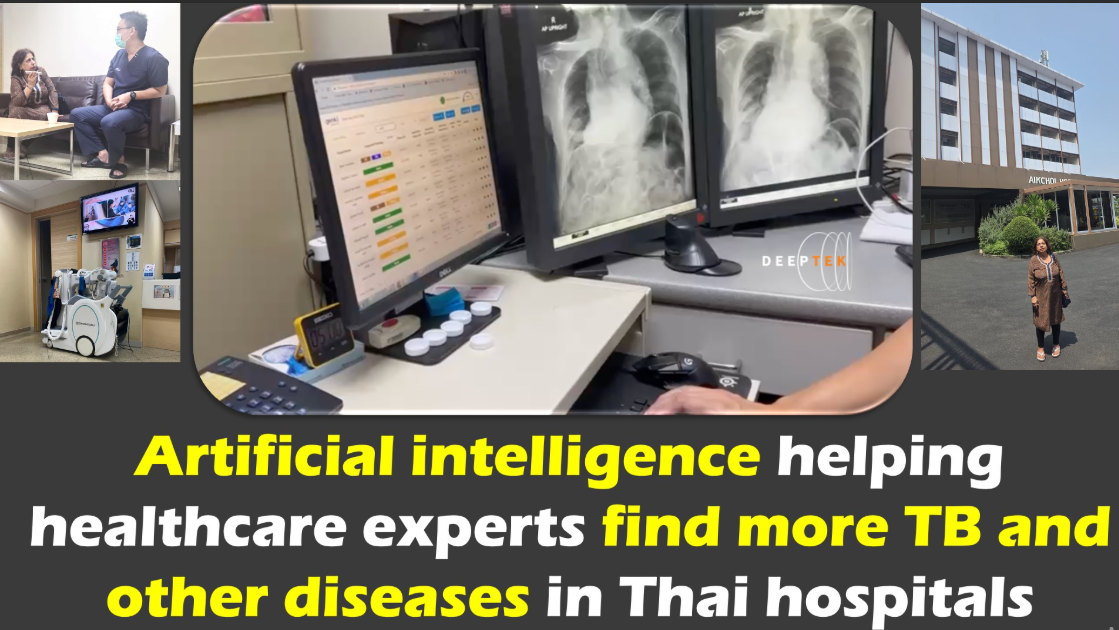
Thailand is deploying many more proven strategies to improve infection prevention and control, find more TB early enough, and link those diagnosed with TB to the right treatment, care, and support. One such proven tool is artificial intelligence (AI), which is helping Thai healthcare professionals not to miss those with TB (and a few other diseases that are screened by AI).
In 2022, the Thailand FDA approved Genki AI, which is an AI-powered lung health screening software (developed by DeepTek) to automate the interpretation of chest X-rays for 27 different pathologies, including TB. Genki is also approved by the US FDA and by regulators of several other countries/regions, such as the European Union, Singapore, India, Malaysia, Kenya, and Indonesia, among others.
Thailand’s FDA approved Genki AI for screening for a range of pathologies, including TB, general opacity, pneumonia, nodules, atelectasis, fibrosis, lung mass, opaque hemithorax, edema, calcification, pleural effusion, pleural thickening, pneumothorax, and cardiomegaly, among others.
AI turning point of 2021
In July 2021, the WHO had integrated AI-powered computer-aided detection software into its official guidelines for TB screening and diagnosis to help bridge the “missing millions” gap in TB detection. AI-powered software can be used to interpret digital chest X-rays for TB screening.
This was historically the first time ever that AI-powered computer-aided detection software was recommended for use in interpreting chest X-rays for TB. Many studies have shown that AI-enabled computer-aided detection software can find TB very accurately in large groups of people, and its performance is similar to that of human readers. Moreover, AI-enabled TB screening tools, like Genki, are highly cost-effective in resource-limited high-burden settings.
CNS Managing Editor Shobha Shukla visited one of Thailand’s hospitals, which is almost half a century old, in Chonburi province, Aikchol Hospital, where noted radiologist Dr. Grisit Prueksaritanond has been using Genki AI for over a year now. Chonburi province is among those Thai provinces, like Bangkok, notable for higher TB rates.
Dr. Grisit shared insights on how Genki AI is helping him detect TB and other lung abnormalities. Aikchol Hospital has X-rays, including a mobile X-ray (of Shimadzu, Japan) powered with Genki AI.
Among over 1000 chest X-rays scanned in a year with Genki AI (as well as by Dr. Grisit), it helps Dr. Grisit reconfirm his X-ray interpretation and diagnosis and has helped him stop missing 3 cases with lesions, which otherwise (without Genki AI) would have been missed.
“Genki AI is crucial. I think it is very helpful,” said Dr. Grisit.
Multi-disease AI screening is a boon, too.
Dr. Grisit points out that when Genki AI helps detect an abnormality in the lung, “It is already very helpful.” This needs to be followed up with a medical expert’s further investigations (like confirmatory tests and expert medical assessment and advice), be it general opacity, TB, a nodule, fibrosis, or a lung mass, among others.
Dr. Grisit reflected that “as long as it (Genki AI) can detect something in the lung, I can evaluate further.” “Sometimes, I just might have missed it wholly if I were not using any program (AI).”
Dr. Grisit pointed out the value of Genki AI screening of chest X-rays in finding not just more TB but also those with fibrosis, pneumonia, pneumothorax, and nodules.
It is noteworthy that the WHO has also shifted to a multi-disease elimination approach in recent years.
Do not misdiagnose, but diagnose early and correctly.
Dr. Grisit emphasized the importance of identifying every patient with a lung abnormality. Over the past year, AI assisted him in accurately diagnosing at least three cases that would have otherwise gone unnoticed. “So, I think that is worth more. It is very sensitive – it is more sensitive than my eyes. So that’s better!”
Dr. Grisit says that in settings where the availability of radiologists is scarce, AI can be a bigger boon.
Thailand is a higher-middle-income country. But availability of human experts is often scarce in low- and middle-income countries. So it saves the time of experts, where AI can be of help. And who benefits the most? The underserved people.
In general, AI has become a substitute for human expert readers in settings where such experts (e.g., radiologists or trained medical officers) are unavailable to detect TB-related abnormalities and to avoid delays in the care pathway, particularly in low- and middle-income countries. For example, the Indian government has deployed AI-enabled handheld X-ray devices to screen high-risk populations for TB.
While referring to AI computer-aided detection of TB, Dr. Grisit said, “I think it is quite useful for the country that has few radiologists, and it is also quite helpful if you have a radiologist because AI can double-check that he or she is not missing any findings in the chest X-ray.”
Triaging those who do not have a disease
Especially in high-burden, low-resource settings, it is important to triage individuals who are unlikely to have the disease. AI is a great help in this context, said Dr. Grisit. “Ruling out people who do not have any problem is important, and it is much quicker this way (so that those with some health problems can access care earlier). Otherwise, it would be a very tedious process for healthy people to get ruled out.” Dr. Grisit underpins the importance of medical experts (which is often a legal mandate too) while we expand the use of AI in health systems.
With 56 months to end TB, Thailand – and the world – has to keep the #endTB and #SDGs promise. We have to prevent people from getting infected with TB disease as a human rights imperative – and those with TB bacteria must access standard care in a person-centered, rights-based, and gender-transformative manner, where no one is left behind.


