 0
0
 0
0
By Shobha Shukla
Even before 2026 began, we were never on track to deliver on gender equality and human rights to health and broader development justice. For example, there has been hardly any decline in gender-based violence perpetrated by intimate partners and others since 2000. Despite promises to end female genital mutilation/ cutting by 2030, rates have instead increased by 15% over the last 8 years.
This does not mean that there is no progress on gender equality and the right to health, but categorically means that despite anti-rights pushbacks, human rights defenders have been able to resist them and push the needle towards making some progress towards SDG-3 and SDG-5. But we have a long way to go to keep the promises enshrined in these goals and targets and other similar legally binding treaties and agreements.
Less than 5 years (59 months) are left for governments to deliver on the 2030 targets. But anti-gender pushbacks continue. The year 2026 has opened with growing backlash against gender equality, like the US withdrawal from 66 international organisations, such as those working to advance gender equality, including 31 UN entities. A few other countries are also towing the US line.
“We need to understand and acknowledge the sinister link between gender injustice and patriarchy, capitalism, militarisation, and religious fundamentalism. We owe a lot to countless feminist leaders who championed the cause of gender justice for decades. It is because of them that we were able to make some progress despite the pushback historically. Frontline defenders of health, safety, and rights of girls, women, and gender diverse people continue to protect the gains made and resist such pushbacks,” said Shobha Shukla, Coordinator of SHE & Rights (Sexual Health with Equity & Rights) initiative.
“The US government’s withdrawal from UN organisations, including the World Health Organization (WHO), is of deep concern. It appears as if gender equality, right to health, and human rights are of no interest to them, women and girls, and people in all their diversities. US withdrawal has also unleashed an economic crisis for several human development programmes, as withdrawal also comes along with the suspension of US funding. But other countries are stepping up their development financing, which gives some hope,” said Dr Mabel Bianco, noted feminist leader, physician activist, and founding president of FEIM (Foundation for Studies and Research on Women), Argentina.
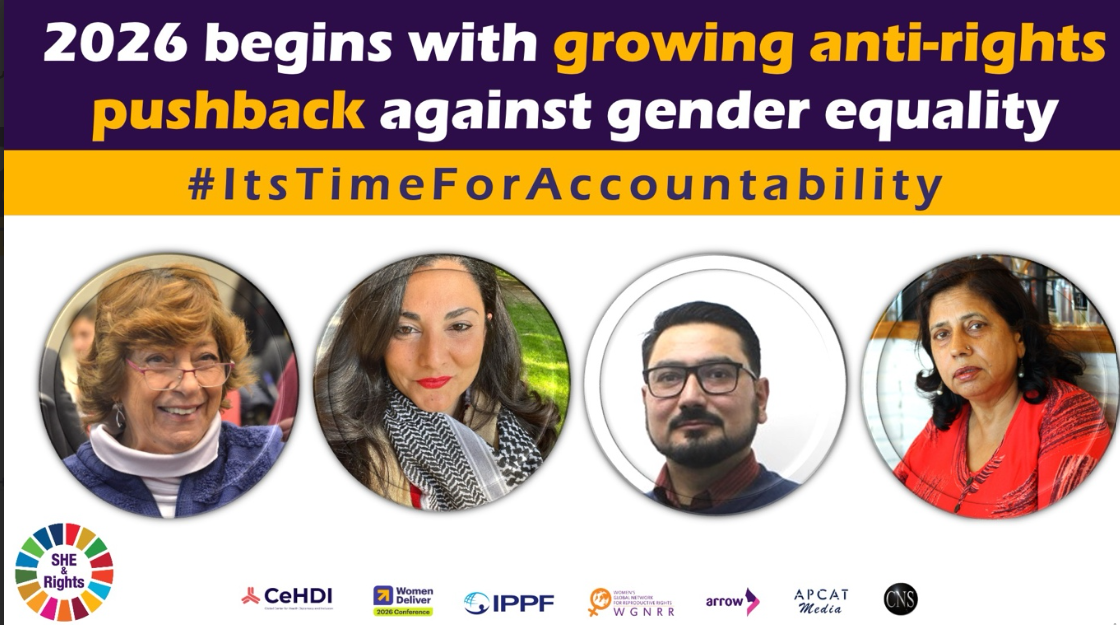
Mabel Bianco was the opening plenary speaker at SHE & Rights January 2026, co-hosted by Global Center for Health Diplomacy and Inclusion (CeHDI), Women Deliver Conference 2026, International Planned Parenthood Federation (IPPF), Women’s Global Network for Reproductive Rights (WGNRR), Asian-Pacific Resource and Research Centre for Women (ARROW), Asia Pacific Media Alliance for Health, Gender and Development Justice (APCAT Media) and CNS.
The negative impact of the US withdrawal will also impact regions and countries in the Global South.
“When funding shrinks, gender responsive health programmes are often the first to be de-prioritised. This creates the space for more conservative or regressive actors to influence global agendas. The result is just not the slow progress but, in some cases, active rollback of hard-won gains, particularly around bodily autonomy, LGBTQI+ rights, and adolescent health. Such global pushbacks like that by the US cascade down to the region, too. Regions such as South Asia or Southeast Asia rely heavily on multilateral mechanisms for gender and health programming. This shift often weakens right-based programming and replaces it with the short-term or politically conditional assistance,” said Tushar Niroula, gender justice advocate and former Executive Director, Marie Stopes International Nepal.
“Possible implications at the country level, such as in Nepal, could be humongous because Nepal has made notable progress in gender equality and health outcomes, such as a reduction in maternal mortality and increased women’s political representation. Much of this progress has been supported by UN agencies including UN Women, UNFPA, UNICEF, and WHO, and US withdrawal affecting these agencies can result in reduced technical and financial support for gender responsive health policies, slower progress on sexual and reproductive health services, especially in remote areas, and challenges in sustaining the gains in maternal adolescent and reproductive health,” he added.
Are the gains made on health and gender fragile?
“In the past US has been involved in supporting several important initiatives to protect people in low- and middle-income countries, such as in Africa, or Latin America and the Caribbean, from malaria, HIV, and TB. Sudden stoppage of funding is disruptive. There are a lot of countries that were forced to reduce their health activities, especially around sexual and reproductive health. USA does not seem to believe in multilateralism,” said Dr Bianco.
“One of the first UN agencies the USA has withdrawn from are UN Economic and Social Councils for Latin America and the Caribbean, Asia and the Pacific, or others. This is a sudden and disruptive jolt to these Councils because, for example, the Latin American one was funded by the USA. So, now we have a crisis. However, it is important to note that the USA has not said anything about stopping being a part of the UN Security Council. We need to review the USA’s withdrawal in the context of how it is acting against Venezuela, Gaza, Greenland, and others,” rightly said Dr Bianco.
“We need to work together. All countries that stand for gender equality, diversity, inclusion, and human rights must unite and work together against this anti-rights push by a few rich nations that have economic, political, and military might. We need to resist together and advance progress towards gender equality and human rights,” said Dr Bianco.
Global South-led and feminist agenda-driven multilateralism
“Mabel has rightly said that we are facing a crisis of multilateralism. This crisis has been exacerbated by the postures of the US administration, but it was brewing before because of double standards in the application of international law. Genocide in Palestine has further exposed the fault lines. It has been brewing because of the double standards in how we address different crises. This is what PM of Canada had also referred to in Davos, that the multilateral system was steeped in colonialism. So, it was fragile and volatile since the start,” said Paola Salwan Daher, Senior Director for Collective Action, Women Deliver.
“We also do not want a world without multilateralism. We know what a world without multilateralism would look like, and it is not a world that we want to live in. So now is the time to reimagine collectively what multilateralism can look like. How do we make it people-centred? How do we make accountability the root of everything and every process in every global space? How do we ensure that States respect their legal obligations? And what does it mean in a time of erosion of multilateralism to still use multilateral spaces as a site of accountability?” she added.
Patriarchy never takes a vacation, and neither will we stop till we achieve gender justice for all.
“Feminist movements have historically organised, but unfortunately, patriarchy never takes a vacation. Therefore, we, the feminists, have never stopped organising. Whether it was around Beijing (Beijing Declaration and its Platform for Action 1995), Cairo (International Conference on Population and Development or ICPD and its Programme of Action 1994) – in the context of amplifying each other’s agenda, feminist movements have always organised,” said Paola.
“The current political moment is a bit different from what we have been facing in the past. We are indeed seeing a rise in kind of unapologetic, unabashed, hegemonic masculinity and harmful gender stereotypes that are being spread online and in person, and that are embodied by several governments. And so, with that, we are also seeing a rise in the far-right agenda and fascism or fascistic governments that are bringing this message of ‘women should not have the same rights as men’ because ‘we are somehow less.’ And it’s not just women; it’s all marginalised communities,” added Paola.
WD 2026 is another chance for collective action.
“As convener of a global gender equality conference (Women Deliver Conference 2026) and as Women Deliver, it is important that we continue to meet each other to strategise and mobilise together. This is what we did in Beijing in 1995 and Cairo in 1994. This is what we did during the International Conferences of Women, Commissions on the Status of Women (CSW), and in other global spaces. Women, girls, and feminists have historically leveraged these spaces to be able to push forward our agenda. We are organising to counter the conservative agenda that we are faced with and to push forward a more progressive agenda that really centres the autonomy, rights, and dignity of women and girls,” shared Paola Daher.
“We need to shift the narrative of ‘girls are the leaders of tomorrow’ to ‘girls are leaders of today’. We need to recognise the strong leadership of adolescent girls and young people (in all their diversities). Girls today are mobilising themselves with a strong feminist agenda because when strong conservative fascist attacks are happening on women and girls, girls are particularly targeted,” she added.
Why do decision makers shy away from taking a stand for bodily autonomy?
“Before my current role, I was doing advocacy at the Human Rights Council and other such spaces for a long time. I often felt tensions during negotiations when it pertained to the right to bodily autonomy of girls or to the agency of girls. So, there is a specific resistance to recognising girls as rights holders, as human beings that have their own agency, or those who can make their own decisions. Women Deliver is part of a broader community called the “Girls Deliver Community,” and through and within this community, girls have written a “Girls’ Manifesto” where they articulate their demands and principles around which they want to organise their activism. This manifesto needs to be centred in negotiations and global spaces as well because it comes from them,” rightly said Paola Daher.
“We see the upcoming Women Deliver Conference 2026 as an ongoing strategy space for us to think collectively about what the world is that we want to live in. We have not been defeated, yet fascism is at our doors. How do we build a big progressive and united front with feminist human rights defenders (including adolescent girls and women and people in all their diversities) that enshrines accountability and continues to push forward a progressive agenda,” shared Paola.
Enough of ‘performative solidarity.’
“One of our guiding principles is not ‘performative solidarity’ but standing alongside so close to the people who are being targeted that you also get the backlash yourself – that kind of meaningful solidarity and accountability. We are putting in place safeguards as much as possible (against disruptions by anti-rights and anti-gender propagandists) so that there is no infiltration,” said Paola.
While responding to a question in SHE & Rights January 2026 session, she said, “As Women Deliver, we are also feeling the (negative) impact of the [regressive] Geneva Consensus Declaration at every turn and at every negotiation that we attend. Just a reminder that the Geneva Consensus Declaration is not a multilaterally negotiated document, but rather it is put together by anti-rights organisations that demand that States sign it. It has become further amplified by the Trump administration. The Geneva Consensus Declaration is not a document that bears any kind of legal bearing. We are hoping that the feminist playbook that Women Deliver and partners are working on acts as a counter and provides a feminist narrative.”


